Application Note B-TA2047
Introduction
TG-FTIR is a technique that enables real-time analysis of gas components evolved during heating by Fourier transform infrared spectroscopy (FTIR). Its advantages include easy estimation of gas species based on functional-group information, a simple instrument configuration that does not require a vacuum pump, and measurement under nitrogen or air atmospheres commonly used with TG and STA. For these reasons, it is widely used for evolved gas analysis in many fields, including material pyrolysis and combustion. Here, we demonstrate the co-combustion behavior of coal and biomass (chicken manure) evaluated by TG-FTIR. Mixing chicken manure with coal has attracted much attention as an approach that contributes both to reducing environmental impact and to the effective use of energy resources, making it important to understand the combustion behavior.
Measurement and Analysis
In this study, TG-FTIR measurements were performed on coal, chicken manure, and their mixed samples. Approximately 5 mg of each sample was weighed into a platinum pan, introduced into the STA, and heated under a dry-air flow of 200 mL/min.
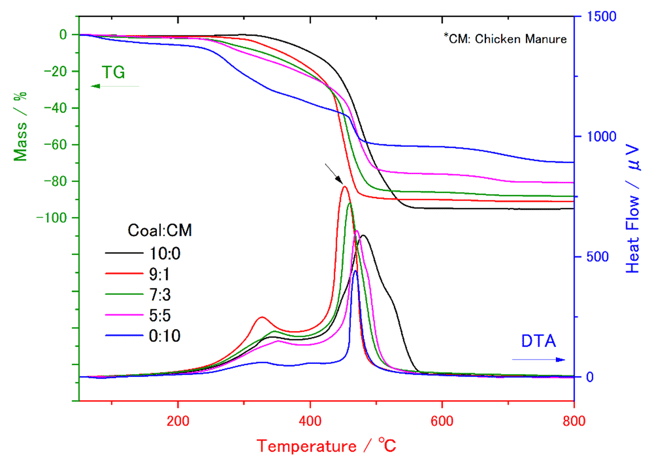 Figure 1: STA measurement results for each sample in an air atmosphere
The STA measurement results are shown in Fig. 1. Coal showed mass loss accompanied by exothermic behavior between 300 and 600°C, indicating that combustion proceeded in this temperature range. In contrast, chicken manure showed gradual mass loss and exothermic behavior from 200 to 450°C, suggesting the release of volatile components and partial combustion. The sharp exothermic peak and mass loss near 500°C are attributed to combustion of carbonaceous components, while the mass loss near 700°C is attributed to decomposition of carbonates. In the mixed samples, the onset temperature of mass loss and the exothermic peak shifted to lower temperatures compared with the coal-only sample. This result suggests a chemical interaction that cannot be explained by simple physical mixing alone.
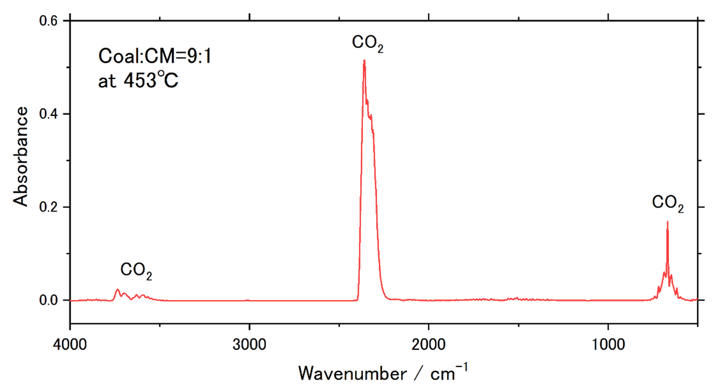 Figure 2: Infrared spectrum at 453°C for a mixed sample of coal:chicken manure = 9:1
Infrared spectra of the evolved gases provide further insight into the reaction. Figure 2 shows the infrared spectrum at 453°C, where a sharp mass loss and exothermic peak were observed for the coal/chicken manure mixed sample at a ratio of 9:1. CO₂ was the main evolved gas in this temperature range, indicating that combustion was occurring. The infrared absorption signal intensity of CO₂ enables a detailed evaluation of the interaction between coal and chicken manure during co-combustion. Figure 3 shows the temperature dependence of CO₂ evolution for each sample. The black lines represent the measured CO₂ IR area intensity, while the red lines represent values calculated from the measurement results of each individual component based on the mixing ratio. For the mixed samples, the measured values deviated markedly from the calculated values, suggesting interactions between the components. In particular, the shift of the measured values toward lower temperatures suggests improved ignitability and accelerated combustion due to co-combustion. This interaction was most pronounced at the 9:1 mixing ratio. These results demonstrate that TG-FTIR can reveal subtle differences in reaction behavior during co-combustion processes.
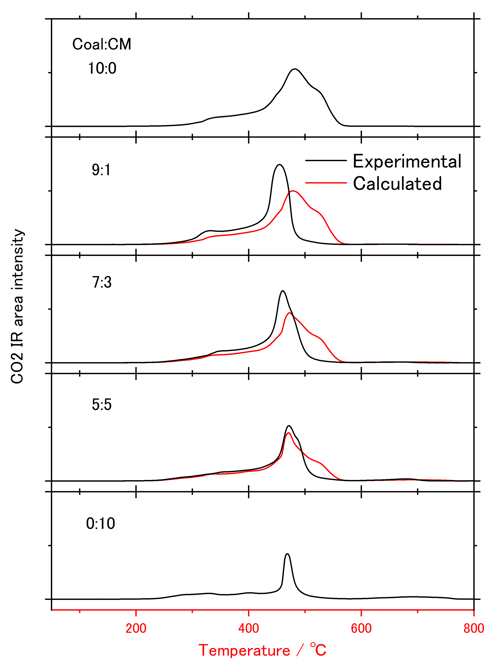 Figure 3: Temperature dependence of CO₂ evolution behavior for each sample
The residues after heating were also observed using the sample observation function. Figure 4 shows optical images of the residues after heating coal alone, chicken manure alone, and a 9:1 mixed sample to 800°C. In the mixed sample, the residue was observed to shrink into a disklike shape at the center of the container. This behavior reflects sintering or melting of the ash caused by interactions between the ash components of chicken manure and coal.
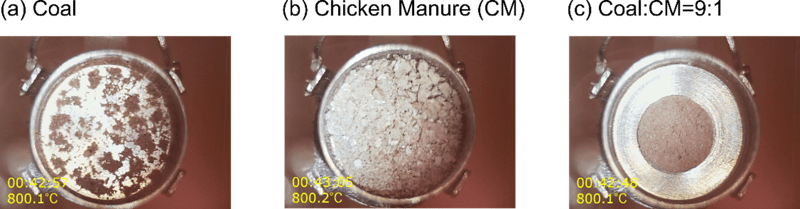 Figure 4: Residues of each sample
Chicken manure contains relatively high levels of alkali and alkaline-earth components, such as potassium and calcium. Coal ash, on the other hand, generally consists mainly of silica and alumina. When these materials are mixed and heated, chicken-manure-derived components may react with silica derived from coal ash to form a low-melting eutectic phase. As a result, some ash particles soften or melt, promoting interparticle bonding and densification, which is observed as shrinkage of the ash.