Application Note B-TA1076
Introduction
Normal paraffins contained in some heavy oils and diesel fuels precipitate and grow as crystals in low-temperature regions, forming wax.
In the case of diesel fuel in particular, the reduced fluidity caused by wax precipitation can lead to clogging of fuel supply lines and filters, resulting in difficulty in engine starting and reduced engine power output.
In this study, crystallization temperature due to the exothermic peak during cooling process and the disappearance temperature of the endothermic peak due to melting during heating process were measured by DSC using heating and cooling scans.
Measurement and analysis example
For the DSC measurement, 20 mg of diesel fuel was placed in a sealed aluminum pan, and was carried out at cooling and heating rates of 2 °C/min.
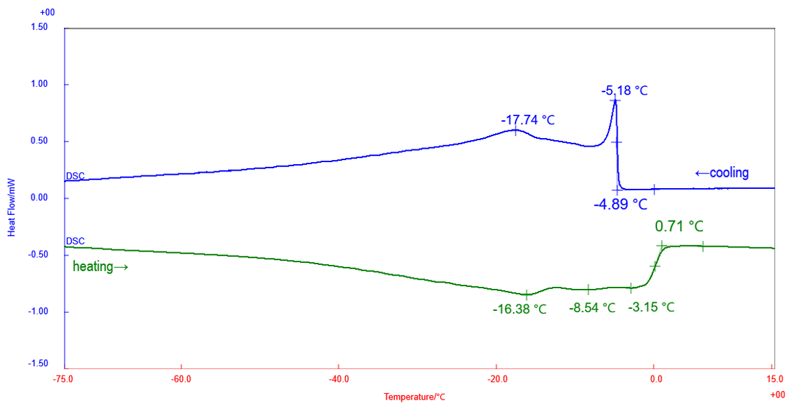
Figure 1: DSC Measurement result
During the cooling process, continuous exothermic peaks due to crystallization were observed from around −5 °C to −75 °C. These results indicate that wax precipitation (crystallization) starts at approximately −5 °C, leading to a decrease in fluidity.
In contrast, during the heating process, continuous endothermic peaks due to melting were observed from around −75 °C to 0.6 °C. At approximately 0.6 °C, the diesel fuel returns to a liquid state, and fluidity is considered to be restored.
Thus, measurement of the crystallization (precipitation) onset temperature during cooling and the melting endset temperature during heating by DSC is useful for evaluating the fluidity of diesel fuel during storage and/or transportation.
The crystallization onset temperature observed during the cooling process (the onset temperature of the exothermic peak) represents the temperature at which wax crystals begin to appear under specified conditions and is referred to as the Wax Appearance Temperature (WAT).
In contrast, the melting endset temperature observed during the heating process (the endset temperature of the endothermic peak) represents the temperature at which wax crystals completely disappear and is referred to as the Wax Disappearance Temperature (WDT).
These temperatures are defined in standards such as ASTM D8420 and IP 389 as representative parameters for evaluating wax behavior in fuels. The WAT and WDT are applicable to evaluate the low-temperature fluidity of diesel fuel as indicators consistent with the concepts outlined in these standards.