Application Note B-TA1065
Introduction
The glass transition of amorphous polymers is detected by DSC as a shift of the baseline toward the endothermic side (a stepwise change), but it may occasionally appear accompanied by an overlapping endothermic peak during the heating process. In this study, the glass transition behavior of PET resin, epoxy resin, and fluoroelastomer was compared by varying the cooling conditions during the initial heating (1st heating) and upon passing through the glass transition temperature, followed by reheating, to investigate the relationship between cooling rate and glass transition.
Measurement and results
For the samples, 12 mg of PET, 15 mg of epoxy resin, and 30 mg of fluoroelastomer were each placed separately into open aluminum pans and analyzed by DSC. All samples were initially heated at a rate of 10°C/min (1st.Heating). Subsequently, the PET samples were cooled at rates of 20°C/min and 2°C/min, while the epoxy resin and fluoroelastomers were cooled at a rate of 2°C/min. Afterward, all samples were reheated at a rate of 10°C/min.
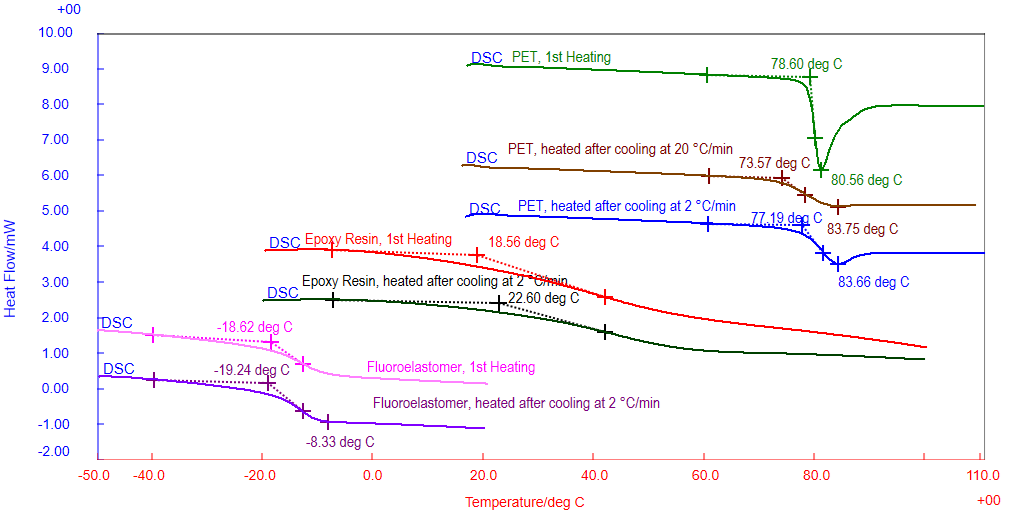 Figure 1 Comparison of DSC Results
The DSC results for PET show a baseline shift due to the glass transition at approximately 75 °C. However, overlapping endothermic peaks were observed in both the 1st heating and the reheating after cooling at 2°C/min. The glassy state can be understood as a state in which a liquid is supercooled without crystallizing. As the temperature decreases, the relaxation of the molecular structure slows significantly, resulting in the formation of a non-equilibrium amorphous solid. In the glassy state, depending on its thermal history, a substance may possess excess enthalpy compared to its equilibrium state. Since this excess enthalpy is dissipated during the heating process, this phase transition occurs as a glass transition accompanied by an endothermic peak.
This phenomenon is known as enthalpy relaxation, and it varies depending on the physical properties of the sample as well as its thermal history such as the cooling rate through the glass transition temperature and the duration for which it is held below that temperature. The result from the 1st-heating DSC of PET suggests that the sample had been stored for an extended period below its glass transition temperature. Furthermore, comparison of the results obtained after cooling at 20 °C/min and 2 °C/min indicates that a slower cooling rate leads to a larger endothermic peak resulting from enthalpy relaxation.
In the case of cured epoxy resin, no endothermic peak was observed even during reheating after cooling at 2 °C/min, indicating that enthalpy relaxation was negligible. For the fluoroelastomer sample, a small endothermic peak was observed near −8 °C during reheating after cooling at 2 °C/min, which is attributable to enthalpy relaxation.