Application Note B-TA1060
Introduction
n-Paraffins, found in some heavy fuels and diesel, crystallize and grow to form wax at low temperatures. This can result in a loss of fluidity, clogging fuel supply lines and filters, and potentially causing engine starting difficulties and loss of power. Measuring the wax appearance temperature (WAT) during the cooling process using DSC can provide information about the usable temperature range of diesel.
Measurements and results
Approximately 20 mg of diesel fuel was placed in an aluminum sealed pan and cooled at cooling rates of 5°C/min and 2°C/min using a DSC equipped with a refrigerated cooling unit, and the exothermic peak behavior associated with crystallization was measured.
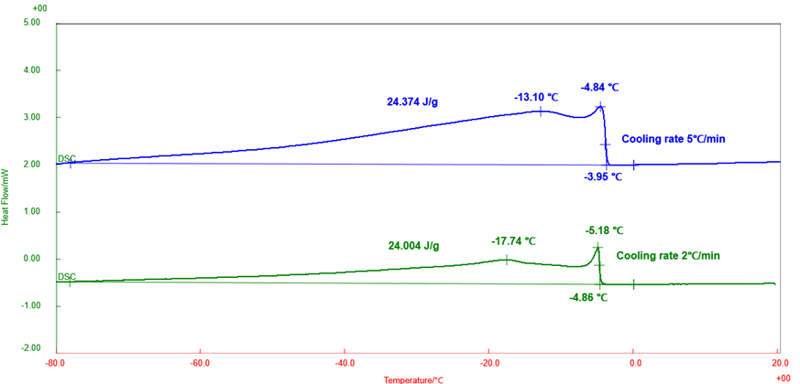
Figure 1: Comparison of DSC results
On the DSC at a cooling rate of 5°C/min, continuous exothermic peaks due to crystallization appear from around -4°C to -80°C, while at 2°C/min, continuous exothermic peaks appear from around -5°C to -80°C.
For the diesel oil sample, no significant difference in WATs was observed during 5°C/min and 2°C/min cooling processes, suggesting that wax formation by n-paraffin crystallization occurs in approximately the same temperature range.
Diesel fuels currently on the market contain Cold Flow Improvers (CFIs) that improve low-temperature fluidity depending on the region and season.
For the evaluation of the low-temperature fluidity of such diesel oils, it is effective to measure and compare the crystallization onset temperature (WAT) during the cooling process using DSC.