


Application Note B-TA1079
Introduction
Wood is widely used in various applications such as building materials, furniture, musical instruments, and tableware. In this study, the effect of humidity changes on the expansion and shrinkage behavior of wood was evaluated using humidity-controlled thermomechanical analysis (TMA/HUM).
Measurement and analysis example
Wood used for disposable chopsticks was cut into specimens with a square cross-section of 4 mm × 4 mm and a length of 15 mm.
A constant load of 20 mN was applied, and the specimen temperature was maintained at 23 °C.
The controlled relative humidity was stepwise changed from a dry condition to 90 %RH, and the amount of expansion (shrinkage) was measured. The holding time at each controlled relative humidity level was set to 4 h.
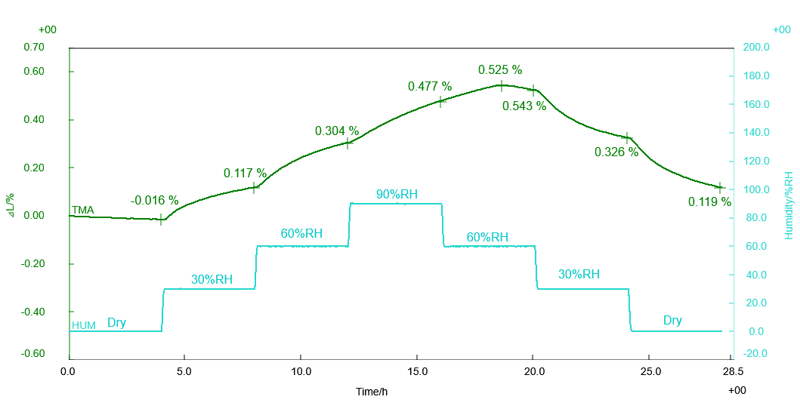
Figure 1: TMA measurement result
Because the controlled relative humidity at the start of the measurement was approximately 35 %RH, a shrinkage of 0.016 % due to drying was observed when the specimen was held under dry conditions. Using this shrinkage amount as the reference (zero), the expansion ratios at each controlled relative humidity are summarized in the table below.
| Dry | 30%RH | 60%RH | 90%RH | 60%RH | 30%RH | Dry | |
| ΔL % | 0 | 0.13 | 0.32 | 0.49 | 0.56 | 0.34 | 0.14 |
Expansions of the wood were observed with increasing relative humidity, while shrinkages were confirmed with decreasing relative humidity.
On the other hand, differences in the expansion behavior were observed in the processes of increasing and decreasing controlled humidity, even with the same controlled relative humidity, suggesting differences in the time required to reach equilibrium.
This tendency was particularly pronounced during the change from 90 %RH to 60 %RH, where expansion continued for a certain period even as the controlled relative humidity decreased.
The measurement results showed that when the controlled relative humidity was changed from dry state to 90% RH, the wood expanded by approximately 0.5%. This method is considered useful for simple evaluation of the dimensional stability of wood in response to humidity changes.