





Electron Diffraction
Creating a single crystal large enough for X-ray diffraction can be very difficult, requiring careful consideration of many factors. This has been a significant barrier in traditional X-ray-based measurements. In recent years, a method called MicroED/3D ED, which uses electron diffraction instead of X-ray diffraction, has gained attention for obtaining three-dimensional structures from crystals smaller than 1 µm.
This method can determine the three-dimensional structure of molecules within a crystal based on the same principles as single-crystal X-ray structure analysis. However, it has some differences and features, such as the ability to analyze the structure of submicron-sized crystals, which is difficult with X-rays. Electron diffraction is a very powerful tool for analyzing complex molecular structures that are difficult to analyze using other structural analysis methods.
Target crystal size
Electron beams interact with the sample 10³ to 10⁴ times more strongly than X-ray beams. Because of this, electron diffraction is particularly suited for analyzing the structure of submicron-sized crystals. It provides an alternative to synchrotron radiation for samples where large crystals cannot be produced. On the other hand, if the sample is too large (or too thick), the electron beam cannot pass through, making data collection impossible. Therefore, it is important to choose between using electron beams and X-rays depending on the size of the crystal to be measured.
Instrument for use
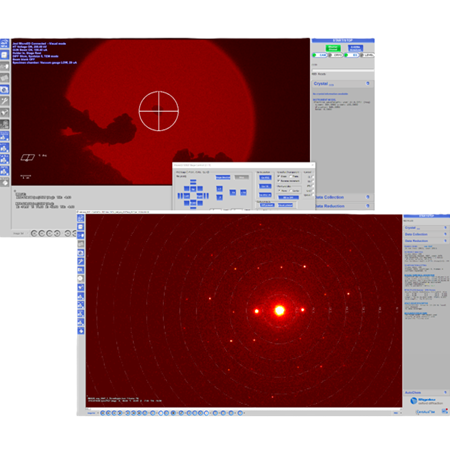
MicroED/3D ED is commonly measured using the electron diffraction function of a transmission electron microscope (TEM). Recently, it is also possible to perform measurements using electron diffraction devices, such as the XtaLAB Synergy-ED.
Applications
Electron diffraction, like X-ray diffraction, is useful in various fields. It can be used to study the structures of a wide range of samples, including pharmaceuticals, small organic molecules, metal complexes, inorganic compounds, MOFs (metal-organic frameworks) and even proteins, playing a crucial role in various fields such as material development, new drug design, and nanomaterial structure evaluation.

Contact Us
Whether you're interested in getting a quote, want a demo, need technical support, or simply have a question, we're here to help.