
Applications of TG-FTIR:
From Polymers to Pharmaceuticals, Foods, and Inorganic Materials

Yoshinobu Hosoi

Winter 2025 Volume 41, No. 1 , 19-24

TG-FTIR, which combines Simultaneous Thermal Analysis (STA) consisting of Thermogravimetry (TG) and Differential Thermal Analysis (DTA) with Fourier Transform Infrared Spectroscopy (FTIR), is an effective method for simultaneously obtaining information about the reactions occurring in a sample upon heating and the resulting reaction products. This paper presents several applications of TG-FTIR in the analysis of polymers, pharmaceuticals, foods, and inorganic materials. In fiber-reinforced plastics (FRPs), bisphenol A is evolved under thermal decomposition, while CO? is released during combustion. For other polymers, H?O and CO? were quantified during combustion. TG-FTIR was also applied to simulate the ceramic debinding process and identify polymer plasticizers. Additionally, TG-FTIR proved effective in analyzing dehydration in pharmaceuticals, thermal oxidation of edible oils, and reactions in inorganic materials such as gypsum dihydrate.
Highlights

  • TG-FTIR combines simultaneous thermal analysis with evolved gas analysis, allowing thermal events to be directly linked to the gases produced during heating.
  • The technique identifies and quantifies reaction products across diverse materials, including polymers, pharmaceuticals, edible oils, and inorganic compounds, providing insights unavailable from thermal analysis alone.
  • Applications range from polymer decomposition and ceramic debinding to pharmaceutical dehydration, food oxidation studies, and gypsum recycling reactions, demonstrating the versatility of TG-FTIR for materials characterization.

Summary

TG-FTIR integrates simultaneous thermogravimetric and differential thermal analysis with Fourier transform infrared spectroscopy to characterize both thermal behavior and the chemical identity of gases evolved during heating. Unlike thermal analysis alone, the combined technique reveals not only when mass loss or thermal events occur, but also the reactions responsible for them.

For polymer analysis, TG-FTIR distinguishes between thermal decomposition and combustion products, identifies resin chemistries through characteristic evolved compounds, and quantifies combustion products such as H₂O and CO₂. Stable FTIR signal intensity enables reliable gas quantification even when the furnace atmosphere changes during analysis. These measurements can be applied to estimate emissions from polymer combustion and to study decomposition mechanisms relevant to recycling and waste management.

The technique is also valuable for ceramic processing, where it can simulate debinding and show how inorganic fillers alter decomposition temperatures and reaction pathways. It can detect additives such as plasticizers by separating volatilization from polymer decomposition, providing detailed information about formulation components.

In pharmaceutical analysis, TG-FTIR confirms whether mass loss results from dehydration or solvent release, making it particularly useful for evaluating hydrates and supporting loss-on-drying studies. For edible oils, it enables real-time observation of thermal oxidation, identifying aldehydes, carbon dioxide, and other oxidation products while correlating chemical changes with thermal events.

Applications extend to inorganic materials such as gypsum, where TG-FTIR tracks dehydration, phase transformations, and high-temperature decomposition. It also clarifies reaction mechanisms during gypsum recycling by identifying the sequential evolution of CO₂ and SO₂, demonstrating its effectiveness for investigating complex solid-state reactions across a broad range of materials.

Frequently asked questions

Recommended products

STA-FTIR

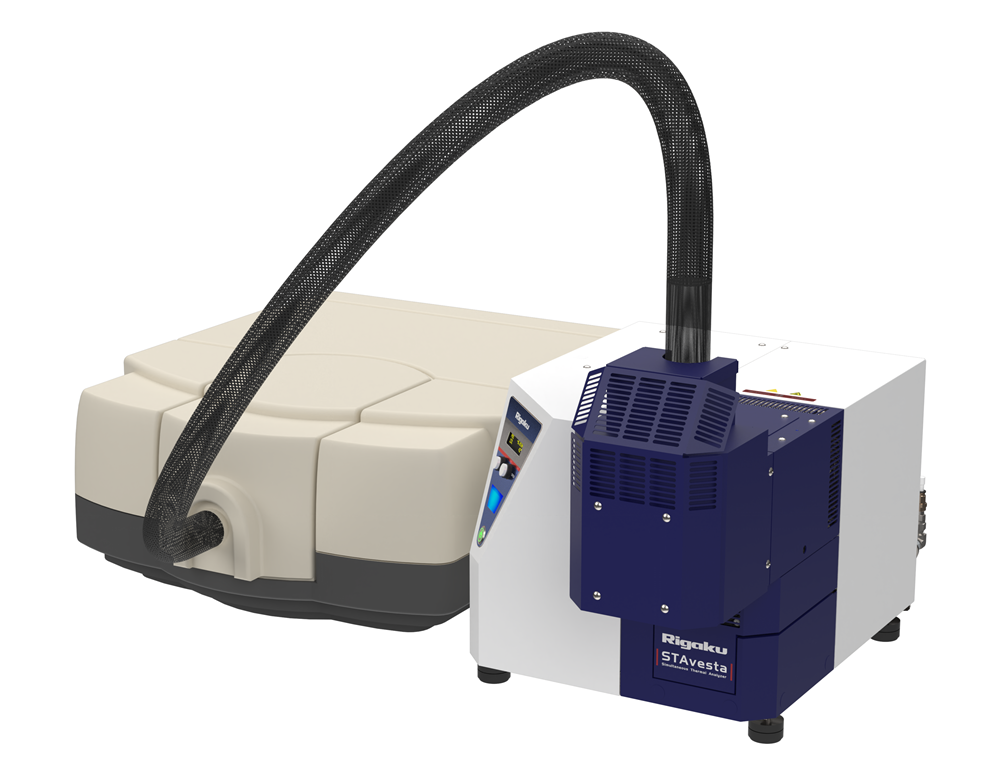
In STA(TG)-FTIR, gases evolved by volatilization or thermal decomposition are qualitatively analyzed, which allows you to track changes in the generated amount along with the temperature change.

Learn more

Contact Us

Whether you're interested in getting a quote, want a demo, need technical support, or simply have a question, we're here to help.