Application Note EDXRF3286

Scope
This application note demonstrates the measurement of 4,5-dichloro-2-n-octyl-4-isothiazolin-3-one (DCOI) in treated wood and wood treatment solutions using the Rigaku NEX QC II energy dispersive X-ray fluorescence (EDXRF) analyzer.
Background
Wood treatments help protect lumber from fungi, insects, UV damage, and general weathering. DCOI is considered a safer and more environmentally friendly alternative to traditional wood preservatives, such as pentachlorophenol (Penta, C₆HCl₅O). DCOI contains no metals and is dissolved in carrier oils or water for use. The carrier oils are specially engineered petroleum- or mineral-based oils containing no sulfur and designed to reduce environmental impact.
DCOI is mainly used to treat utility poles and crossarms. It can also be used for other industrial timber products, including railroad ties and bridge timbers. DCOI can also be used for above-ground residential projects, such as decks and porches.
During the treatment process, DCOI in the treatment solution must be carefully monitored to maintain consistent product quality while minimizing preservative consumption, reducing operating costs, and preventing product rejection. DCOI is then measured in both the treatment solution and the finished wood to ensure proper preservative retention. EDXRF provides a fast, simple, and reliable method for DCOI analysis throughout the quality control process.
Calibration – DCOI in wood
An empirical calibration was developed using a set of assayed wood standards using a measurement time of 100 seconds per sample.
| DCOI Units: % |
||
| Sample I.D. | Standard value | Calculated value |
| 1 | 0.142 | 0.145 |
| 2 | 0.258 | 0.252 |
| 3 | 0.321 | 0.321 |
| 4 | 0.399 | 0.405 |
| 5 | 0.474 | 0.474 |
| 6 | 0.586 | 0.588 |
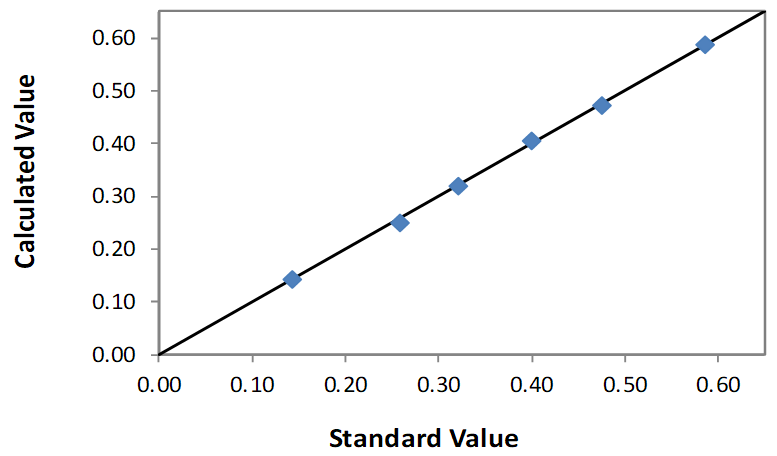
Calibration plot DCOI in wood
Repeatability (precision) – DCOI in wood
To demonstrate repeatability (precision), the low and high samples were selected from the set of calibration standards. Each sample was measured in a static position for ten repeat analyses, using a measurement time of 100 seconds per sample.
| Sample I.D. | Standard Value | Average Value | Std. Dev | % Relative |
| 1 | 0.142 | 0.1491 | 0.0008 | 0.6 |
| 6 | 0.586 | 0.5801 | 0.0022 | 0.4 |
Calibration – DCOI in solution
An empirical calibration was developed using a set of assayed solution standards with a measurement time of 100 seconds per sample.
| DCOI Units: % |
||
| Sample I.D. | Standard value | Calculated value |
| 1 | 4.4518 | 4.4499 |
| 2 | 2.9562 | 2.9641 |
| 3 | 2.5990 | 2.5913 |
| 4 | 2.2312 | 2.2425 |
| 5 | 1.7209 | 1.7045 |
| 6 | 1.4926 | 1.4925 |
| 7 | 1.0959 | 1.1028 |
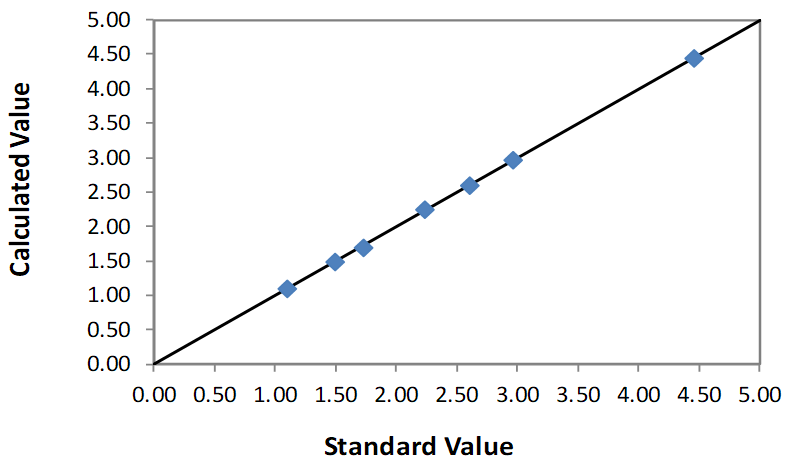
Calibration plot DCOI in solution
Repeatability (precision) – DCOI in solution
To demonstrate repeatability (precision), the low and high samples were selected from the set of calibration standards. Each sample was measured in a static position for ten repeat analyses, using a measurement time of 100 seconds per sample.
| Sample I.D. | Standard Value | Average Value | Std. Dev | % Relative |
| 1 | 4.4518 | 4.4415 | 0.0140 | 0.3 |
| 7 | 1.0959 | 1.1117 | 0.0035 | 0.3 |
Conclusion
The results presented here demonstrate the Rigaku NEX QC II’s ability to provide fast, simple, and reliable measurement of DCOI in treated wood and wood treatment solutions. The Rigaku NEX QC II supports quality control throughout the treated lumber production process, helping manufacturers optimize product quality, reduce costs, and minimize product rejection and waste.