
About the calculator
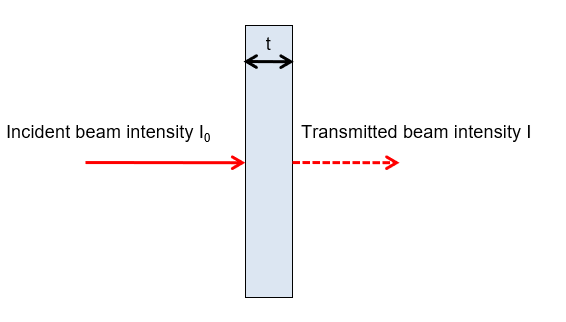
The calculator calculates the ratio between the initial X-ray intensity (I₀) and the transmitted intensity (I) after the beam passes through a uniform material of thickness t.
It can also calculate the thickness (t) of a given material required to absorb X-rays, thereby reducing the transmitted intensity to a certain level, by providing I₀/I. How to use it
- Select an X-ray wavelength or energy.
- Enter the material thickness t or X-ray intensity ratio I₀/I.
- Enter the material’s density ρ and included elements’ mass absorption coefficients (μ/ρ) and weight% (w).
Theory
Variables
| Symbol | Meaning | Units |
|---|---|---|
| I0 | Incident X-ray intensity | cps (counts per second) |
| I | Transmitted X-ray intensity | cps |
| t | Material’s thickness | cm |
| ρ | Material’s density | g/cm3 |
| μ | Material’s linear absorption coefficient | 1/cm |
| μ/ρ | Mass absorption coefficient | cm2/g |
| W | Mass percentage of each element | mass % |
| λ | Wavelength | Å |
| E | Energy | keV |
Beer-Lambert Law relates the absorption of light to the properties of the material through which the light is traveling. It is commonly written as:
\(I = I_0 \cdot e^{-\mu t}\)
The following equation relates the X-ray wavelength and energy:
\(E = \frac{12.397639}{\lambda}\)