Application Note B-XRD1170
Introduction
In the quality improvement and process control of electronic components, it is essential to ensure product quality by preventing foreign material contamination, improving material purity, and stabilizing manufacturing processes. Appropriate evaluation and analysis of materials and foreign objects are therefore indispensable for achieving these goals. X-ray diffraction (XRD) is widely used as an effective analytical technique because it provides information on chemical composition and crystal structure. In recent years, the miniaturization and increasing density of electronic devices have led to the need to evaluate smaller areas using XRD analysis.
When identifying a foreign material, it is desirable to focus the incident X-ray beam to a size comparable to that of the object under investigation so that diffraction signals from areas other than the object can be minimized. However, when the object is approximately 100 μm in size, it is difficult for conventional X-ray diffractometers equipped with micro-area optics to reduce the X-ray irradiation area to 100 μm or less while maintaining a practical measurement time. For the analysis of such small foreign materials, a combination of a high-intensity X-ray source—which provides a high X-ray flux—a high-precision goniometer for stable positioning, and a 2D detector for efficient data collection enables both a small irradiation area and a practical measurement time. Here, we present an application example in which a small amount of black foreign material present on a sintered barium titanate (BaTiO₃) ceramic, a dielectric material, was evaluated using a micro-area X-ray diffractometer equipped with a high-intensity X-ray source, a high-precision goniometer and a 2D detector.
Measurement and analysis
A sintered barium titanate (BaTiO₃) ceramic synthesized from barium carbonate and titanium dioxide was used as the sample. X-ray diffraction patterns were acquired from a black foreign material measuring 100 μm × 300 μm on the sample using the micro-area X-ray diffractometer, DicifferX Microarea Edition. For the measurements, the X-ray irradiation size was controlled using a 0.2 mm collimator, corresponding to the irradiation size of a conventional X-ray diffractometer, and a 0.05 mm collimator designed for micro-area measurements. Data collections were performed for approximately 7 minutes under each condition. Even with the 0.05 mm collimator, the intensity of the strongest peak exceeded 10,000 counts, enabling the acquisition of diffraction patterns with sufficient intensity.
Fig. 1 shows the qualitative analysis results of the black foreign material on the sintered barium titanate ceramic. When the 0.2 mm collimator was used, the X-ray beam irradiated areas outside the contaminant, resulting in overlapping peaks originating from the substance of interest and the surrounding barium titanate ceramic. In contrast, when the 0.05 mm collimator was used to irradiate just the black foreign material, only peaks originating from it were observed. Qualitative analysis revealed that the contaminant consisted of a mixture of barium and aluminum oxides or titanium oxides: BaAl2O4, Ba0.75Al11O17.25 and Ba4Ti12O27.
Even when the X-ray irradiation area is larger than the foreign object, the material can be identified by separately measuring an area outside the contaminant as a reference and determining the peaks generated only by the foreign material. However, by using a collimator to focus the X-ray beam and selectively irradiate only the target area, the analysis can be performed more easily and in a shorter measurement time.
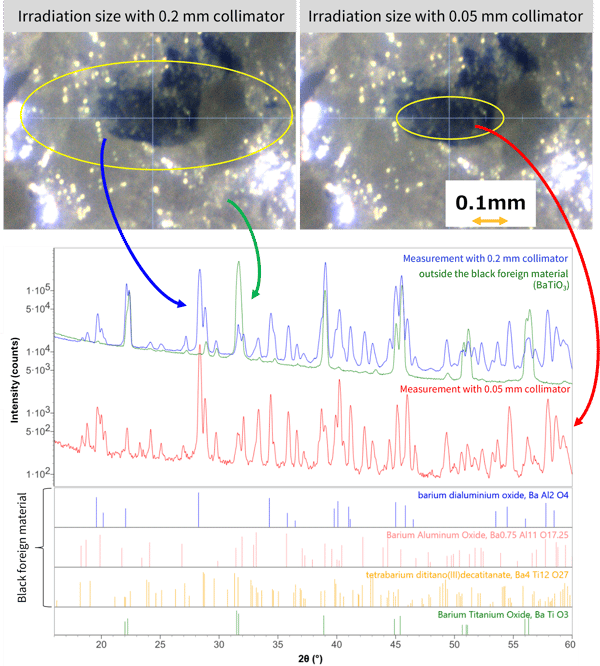 Fig.1: Qualitative analysis results of a black foreign material on a sintered barium titanate ceramic
Recommended equipment and software
- DicifferX Microarea Edition micro-area X-ray diffractometer
- SmartLab Studio II integrated X-ray analysis software (Powder XRD Plugin)