Application Note B-TA1051
Introduction
The effect of thermal degradation due to high-temperature exposure on fluoroelastomer O-rings on dimensional changes (strain) caused by deformation in response to applied load (stress) changes was investigated.
Measurement and results
Samples were prepared using four different conditions: new materials as received and materials treated with exposure to 300°C for 12, 24, and 48 hours. The TMA compression loading method was used to continuously increased the applied load range from 30 mN to 500 mN at a rate of 50 mN/min, followed by a 35-minute holding period. The deformation of the four samples was measured at the point where 500 mN was reached and after the 35-minute holding period.
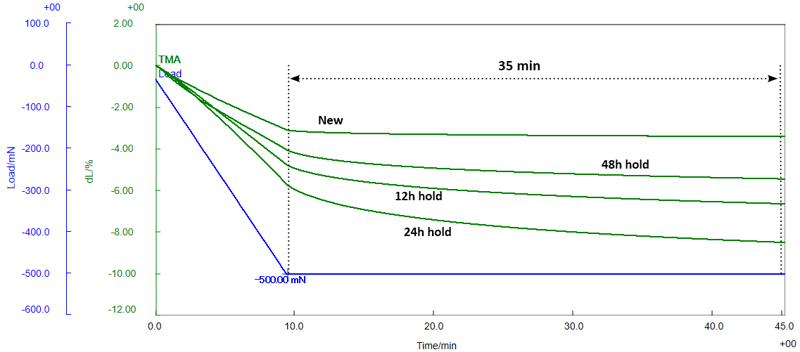
Figure 1: Load-Deformation Plot
Table 1: Comparison of Deformation amount (%)
| ΔL (%) | ||||
| New | 12h | 24h | 48h | |
| (a): Deformation amount until reaching 500 mN |
3.01 | 4.72 | 5.72 | 4.06 |
| (b): Total deformation amount for reaching 500 mN and then being maintained in 35 minutes | 3.41 | 6.63 | 8.48 | 5.44 |
| (c): Deformation amount over 35 minutes after reaching 500 mN: (b) − (a) | 0.40 | 1.91 | 2.76 | 1.38 |
(a) When the applied load reaches 500 mN, a comparison between the new material and the heat-treated material reveals that the amount of deformation in response to load changes increases in the order of 12 h and 24 h holding times, indicating that the samples become softer due to thermal degradation. However, when the holding time was 48 hours, the deformation amount was smaller, contrary to the trend observed for 12-hour and 24-hour holding times. Furthermore, the deformation amount (C) after holding at 500mN for 35 minutes showed a similar trend to (a), suggesting that the rubber softens in the initial stages of thermal degradation and hardens as the degradation progresses.
In this way, comparing the amount of deformation in response to changes in applied load provides useful information regarding rubber degradation.