Application Note B-TA1097
Introduction
It is known that when polymer products are used outdoors for extended periods, their mechanical and physical properties change due to factors such as temperature and humidity fluctuations and exposure to ultraviolet radiation.
In this application, the thermal decomposition behavior of natural rubber sheets exposed outdoors for different periods was comparatively evaluated using TG-DTA.
Measurement and results
Natural rubber sheets (1 mm thick) that had been exposed outdoors for 9 days and 17 days, respectively, were punched into 4 mm-diameter specimens; these were then analyzed using TG-DTA in an air atmosphere at a heating rate of 10°C/min.
Figures 1 and 2 show a comparison of the TG-DTA results for a natural rubber sheets exposed outdoors and a new sheet.
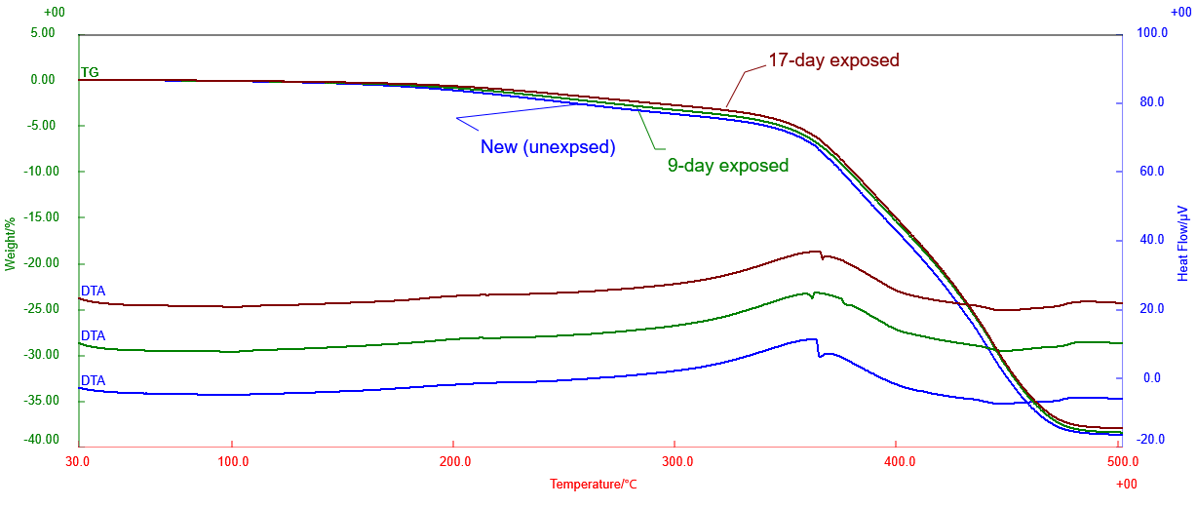 Figure1 Comparison of the TG-DTA results for natural rubber sheets exposed and unexposed
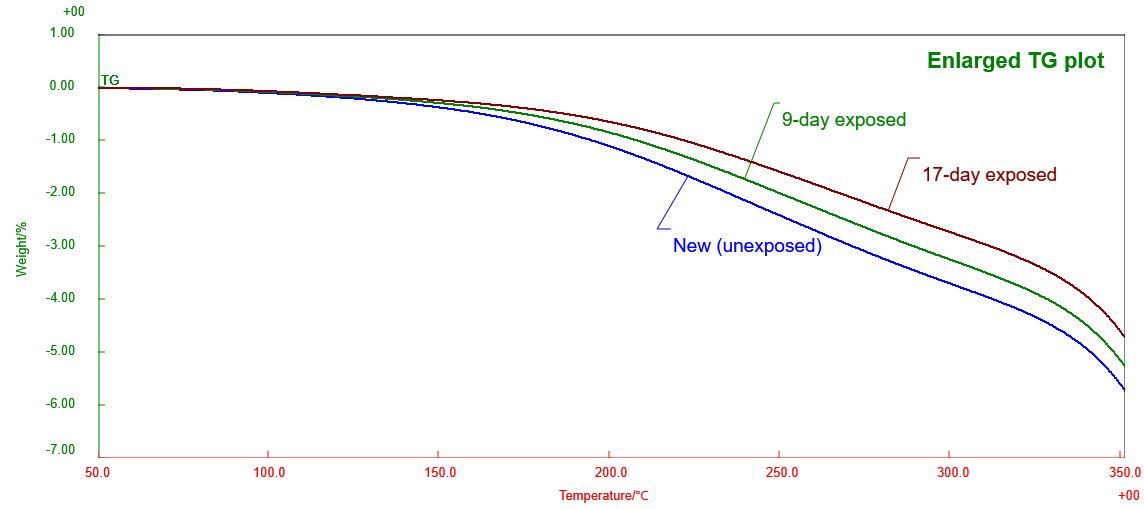 Figure2 Enlarged TG curves (50 °C–350 °C)
For both the unexposed (new) sample and the samples exposed for 9 and 17 days, three-stage mass loss is observed between approximately 80°C and 500°C. Additionally, an exothermic DTA peak appears between 100°C and 400°C, followed by an endothermic DTA peak up to 500°C.
In particular, differences were observed between the samples in the percentage of mass loss up to approximately 350°C, with the unexposed “New” sample beginning to decompose at a lower temperature. When comparing the temperatures at which a 5% mass loss is reached, it can be seen that these temperatures are higher in the following order: 17-day-exposed, 9-day-exposed, and unexposed “New” samples.
Figure 3 shows the plots of mass loss up to 5% versus temperature.
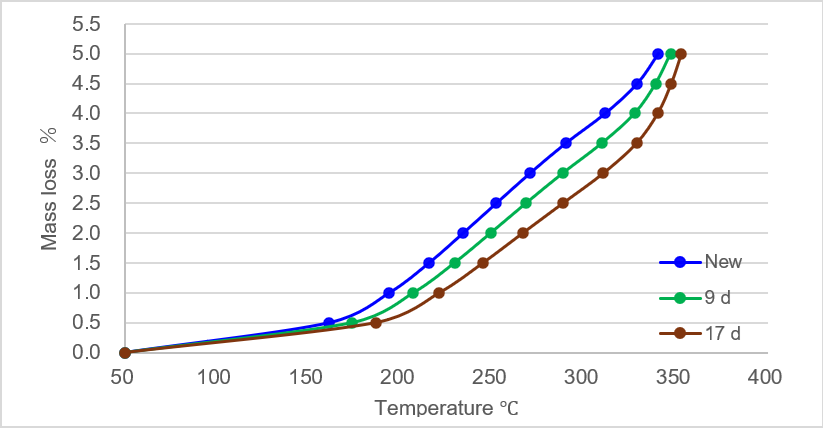 Figure3 Mass loss–temperature plots
As the exposure period increases, the molecular structure of the sample undergoes accelerated degradation due to factors such as ozone oxidation, ultraviolet (UV) radiation, temperature fluctuations, and changes in humidity (moisture). Based on the current measurement results, it is inferred that components that would typically decompose at lower temperatures broke down during the exposure period, leaving behind only those components that decompose at higher temperatures; this has caused the decomposition temperature range to shift toward the higher end.
Actual products contain various additives such as antioxidants, UV absorbers, and light stabilizers to prevent degradation; therefore, comparing the mass loss % during the initial stages of thermal decomposition should provide an indicator for evaluating weather resistance, accounting for the effects of these additives.