Application Note B-TA1080
Introduction
Serpentinite is a hydrous mineral rock primarily composed of serpentine minerals. During heating, structural/bound water (OH) and adsorbed water are released stepwise, resulting in characteristic mass losses and associated endothermic/exothermic reactions in TG‑DTA measurements. In particular, serpentine minerals are known to undergo their main dehydrations in the temperature range of approximately 500 to 650 °C, and the mass loss in this region strongly depends on the serpentine content in the sample.
In this application, the characteristic mass loss rates for different temperature ranges obtained from the mass loss curve were analyzed, and the serpentine content in serpentinite was semi‑quantitatively estimated based on a comparison with the theoretical dehydration rate of serpentine reported in the literature. In addition, mass loss steps originating from minor components are discussed together with interpretation of the measurement results. This analysis was performed under the assumption that dehydration of serpentine is the dominant cause of mass loss in the relevant temperature range.
Measurement and analysis example
Serpentinite powder was used as the sample, and measurements were conducted under an air atmosphere. TG‑DTA measurement was performed at a heating rate of 5 °C/min, while sample-controlled TG (SCTG) measurement was carried out at a constant mass loss rate of 0.06 %/h, both from room temperature up to 1000°C.
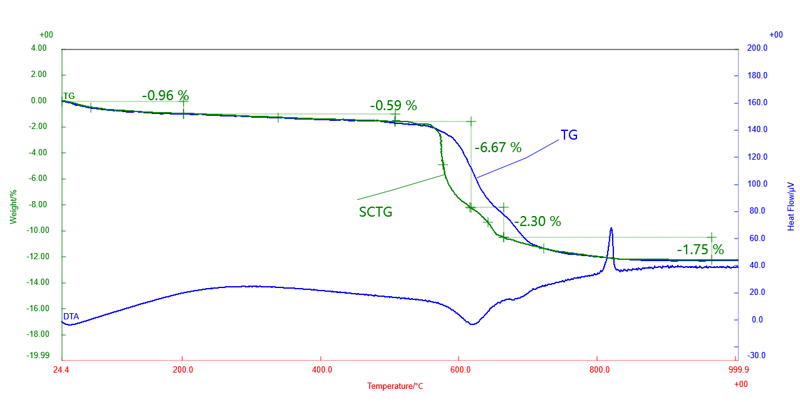
Figure 1: Comparison of SCTG and TG‑DTA measurement results.
From the SCTG curve, a total mass loss of 12.27 % was observed between room temperature and 900 °C. The mass loss behavior was clearly divided into multiple temperature regions, each attributed to different dehydrations.
Table 1: Mass loss rates in each temperature region obtained by SCTG and the corresponding assigned reactions
| Mass loss stage | Temperature range (°C) | Mass loss rate (%) | Main reactions | Estimated components |
| 1 | R.T – 200 | 0.96 | Release of adsorbed water | Surface adsorbed water |
| 2 | 200 – 500 | 0.59 | Dehydration of crystal water | Brucite (approx. 2%) |
| 3 | 500 – 620 | 6.67 | Main dehydration | Serpentine |
| 4 | 620 – 650 | 2.30 | Late-stage dehydration | Serpentine |
| 5 | 650 – 900 | 1.75 | Residual OH and side reactions | Trace amounts of serpentine, carbonates, etc. |
The dehydration of serpentine is typically expressed as:
Mg₃Si₂O₅(OH)₄ → Mg₂SiO₄ + MgSiO₃ + 2H₂O
The theoretical mass loss observed in SCTG was calculated from the mass ratio corresponding to the formation of 2H₂O.
The amount of dehydration in the temperature range of 500 to 650 °C was 8.97 %. Compared with the theoretical mass loss rate of serpentine (theoretical dehydration ratio of approximately 13 %), the serpentine content in the sample was estimated to be about 65–70 %. In addition, 0.59 % mass loss observed between 200 and 500 °C corresponds to dehydration of brucite, and its content was estimated to be approximately 2 %. The remaining components are considered to be mainly anhydrous mineral phases.
These results demonstrate that the serpentine content in serpentinite can be semi‑quantitatively evaluated by analyzing stepwise dehydration amounts obtained from SCTG measurement. This method is particularly effective when combined with solid‑phase analytical techniques such as X‑ray diffraction (XRD), enabling more reliable evaluation of mineral composition.