Application Note B-TA1059
Introduction
The thermal decomposition behavior of a commercially available synthetic automotive engine oil (5W-40, API SN) was investigated and compared among samples aged by holding at 120°C to 180°C for 12 hours each and a sample stored at room temperature (undegraded).
Measurement and results
Engine oil samples were prepared by placing the oil in aluminum pans and holding them at 120°C, 140°C, 160°C, and 180°C for 12 hours; these samples were then heated to 350°C in air atmosphere using STA (TG-DTA).
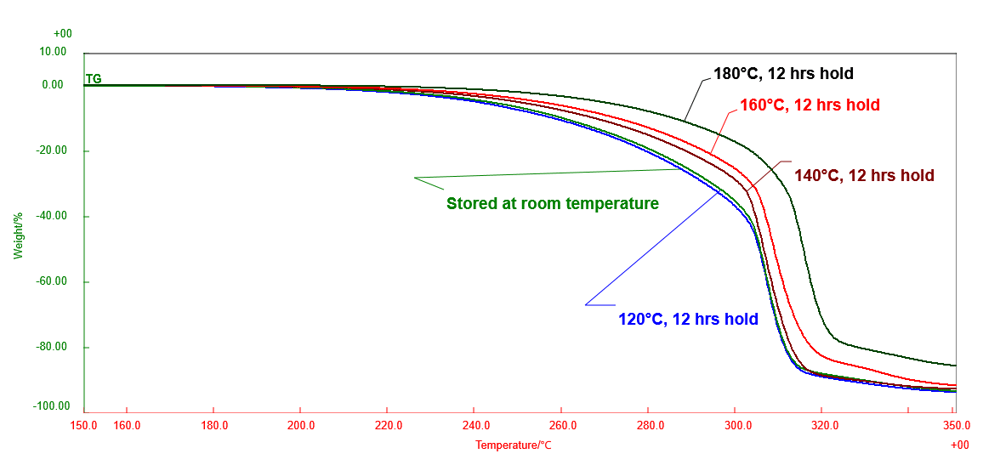
Figure 1 Comparison of STA (TG-DTA) results for engine oils prepared under different degradation conditions
Each sample shows mass loss occurring in three stages between approximately 200°C and 350°C. Notably, differences in the mass loss (%) were observed among the samples, particularly in the range up to around 310°C, with a trend showing that the mass loss (%) decreases as the holding temperature increases. A significant change in mass loss (%) was observed when the holding temperature exceeds 140°C, suggesting a rapid progression of thermal degradation.
Table 1 Mass loss (%) at 310°C
| Sample | Mass loss (%) at 310°C |
| Stored at room temperature | 77.2 |
| After holding at 120°C for 12 hrs | 76.4 |
| After holding at 140°C for 12 hrs | 71.3 |
| After holding at 160°C for 12 hrs | 58.6 |
| After holding at 180°C for 12 hrs | 29.7 |
Table 1 summarizes the mass loss (%) of each sample at 310°C. These results suggest that the material components that undergo thermal decomposition and combustion in this temperature range change in relation to thermal degradation; thus, changes in the mass loss (%) may serve as one indicator for estimating the degree of thermal degradation of the engine oil.