Application Note B-TA1058
Introduction
The thermal decomposition behavior of an edible blended oil (canola oil / olive oil) was measured and compared between samples that had been held at 160°C for a certain period of time to induce degradation and undegraded samples.
Measurement and results
Commercially available edible blended oil was used as the sample. The oil was placed in an aluminum pan and held at 160°C for 6 hours, 12 hours, or 24 hours to prepare degraded samples. The samples were then heated to 600°C in air atmosphere using STA (TG-DTA), and the thermal decomposition behavior was evaluated.
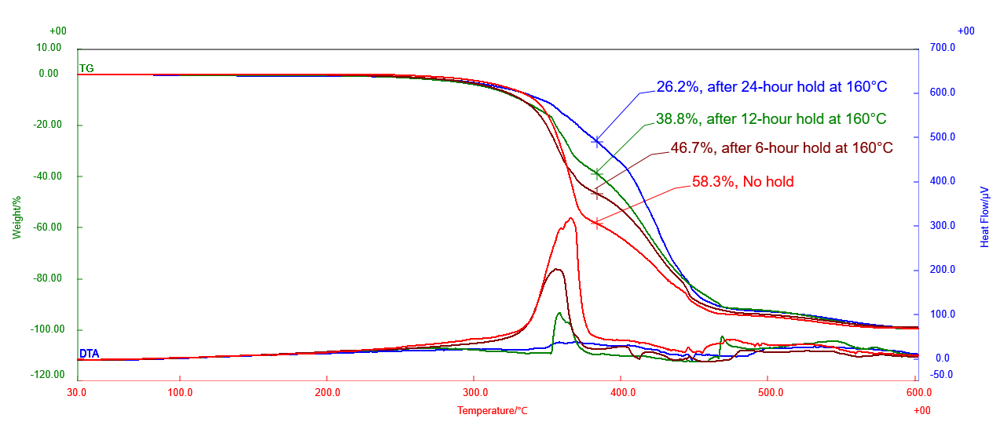
Figure 1 Comparison of STA (TG-DTA) results for degraded and undegraded samples
All samples exhibited roughly four stages of mass loss between approximately 200°C and 600°C. In particular, differences were observed in the mass loss (%) and exothermic peak behavior at temperatures between 300°C and 400°C; longer holding times resulted in lower mass loss (%) and smaller exothermic peaks.
Table 1 Mass loss (%) at 380°C
| Sample | Mass loss (%) |
| No Hold | 58.3 |
| 6 h Hold | 46.7 |
| 12 h Hold | 38.8 |
| 24 h Hold | 26.2 |
Table 1 summarizes the mass loss (%) of each sample at 380°C. The results indicate that material components undergoing thermal decomposition and combustion in this temperature range are associated with thermal degradation, and changes in the mass loss (%) are considered to be one indicator for estimating the degree of thermal degradation.