Application Note B-TA1095
Introduction
The insulation for electrical wires is produced by applying a polymer which has been melted and compounded onto a core conductor such as copper using an extruder; an outer jacket is then applied to complete the cable. Because the coating process involves thermal treatment, the outer jacketing material may retain a "thermal history."
In this application, the thermal history of the outer jacketing material of an electric wire was evaluated using Dynamic DSC (temperature-modulated DSC).
Measurement and results
A flat section of the cable jacket was cut into pieces approximately 2 mm square (about 12 mg), placed in an Al crimped pan, and the measurements was conducted with a heating rate of 5 °C/min with a temperature amplitude of 0.53 °C and a modulation period of 40 s.
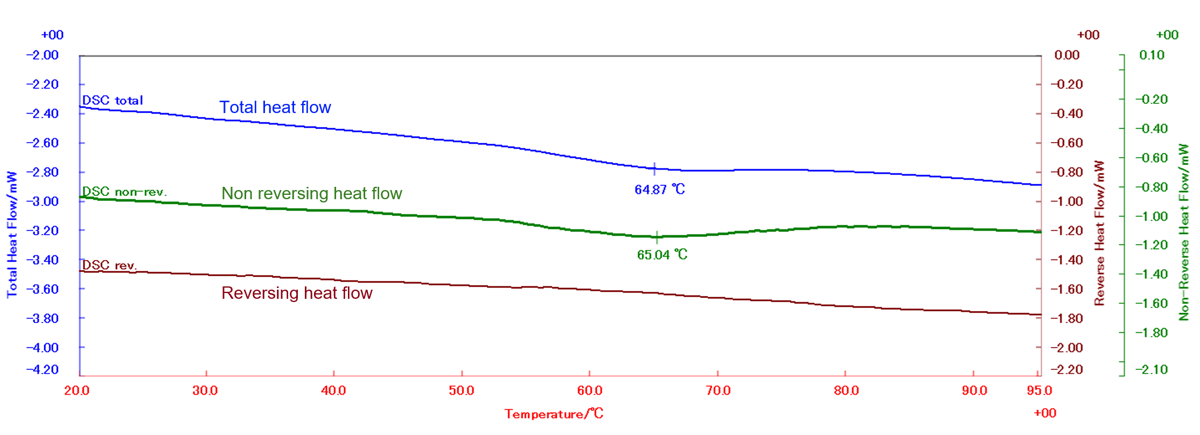 Figure1 Results of Dynamic DSC (Temperature-Modulated DSC) on the outer jacketing material of electric wires
Temperature-modulated DSC (TMDSC) is a measurement technique in which a periodic sinusoidal temperature modulation is superimposed onto a constant heating rate. By applying a mathematical Fourier transform to the resulting TMDSC data, the signal can be separated into three components: total heat flow, which corresponds to the behavior observed in conventional DSC at a constant heating rate; reversing heat flow, which varies in response to the temperature modulation; and non-reversing heat flow, which does not follow the temperature modulation.
In the current measurement results, a broad endothermic peak was observed between approximately 50°C and 80°C in both the "Total heat flow" and "Non-reversing heat flow" curves, whereas no such peak appeared in the "Reversing heat flow" curve. This indicates that the endothermic peak originates from an irreversible change, suggesting that a thermal treatment may have been applied within this temperature range during the outer jacketing process.
Thus, the use of TMDSC makes it possible to distinguish between reversible and irreversible peaks, thereby providing information on the presence of thermal history and the temperature range affected by that history.