Application Note B-TA1055
Introduction
We investigated the effect of thermal degradation caused by high-temperature exposure on the glass transition temperature of fluoroelastomer O-rings.
Measurement and results
The glass transition temperature was measured and compared using DSC for samples prepared by holding at 250 °C in air for 48, 72, and 96 hours, as well as for an untreated sample.
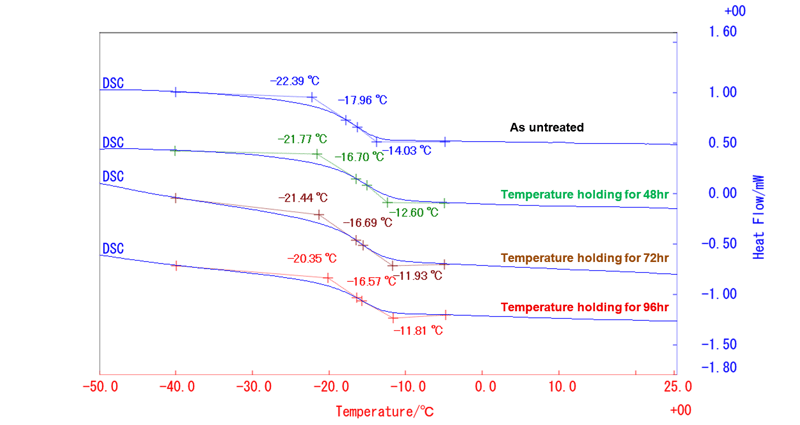
Figure 1: Comparison of glass transition temperatures of samples subjected to different heat treatment conditions
In DSC, the glass transition behavior appears as a baseline shift toward the endothermic direction (stepwise change). For rubber materials, the glass transition generally occurs below room temperature, and below the glass transition temperature, the material becomes an amorphous solid and therefore cannot be used as elastic materials.
In the present results, comparison of the glass transition temperatures appearing around −20 °C to −12 °C for the untreated (new) sample and samples subjected to different heat treatment conditions revealsa tendency for the glass transition temperature to shift slightly toward higher temperatures with increasing heat treatment holding time. This suggests that if the material is used at temperatures above room temperature for an extended period, degradation will be accelerated, leading to hardening and a potential reduction in sealing performance as an O-ring.
Recommended equipment and software
- DSCvesta2 + refrigerated cooling unit
- Vullios, Measurement and analysis software