Application Note B-TA1070
Introduction
Electric wire insulating sheaths are manufactured by extruding a melted and kneaded polymer material onto a core wire such as copper, applying an insulating sheathing, followed by applying an outer sheathing to form cables. Thermal history may occur due to heat treatment during the sheathing process. Therefore, we measured the thermal history of the outer sheathing material using DSC and TMA compression loading method.
Measurement and analysis example
For the DSC measurements, a flat portion of the cable's exterior coating was cut into a 2mm square (approximately 12mg) and placed in an aluminum pan, where it was heated at 10°C/min. For the TMA measurements, a similar flat portion of the exterior coating was cut into a 10mm length piece and heated at 5°C/min under a load of 20mN. Both measurements involved 1st heating and 2nd heating (reheating).
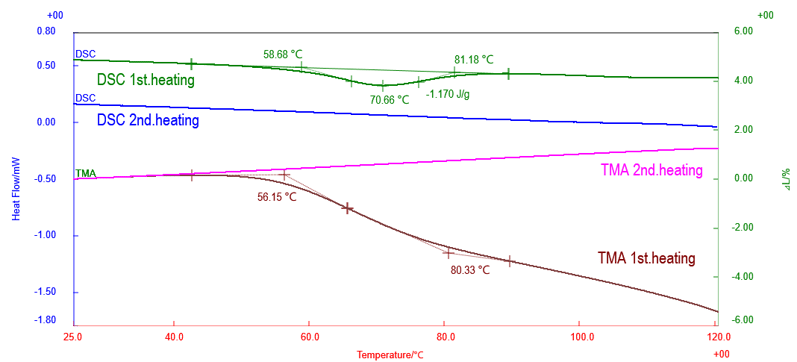
Figure 1: Comparison of DSC and TMA measurement results
The DSC results showed a broad endothermic peak between 60 °C and 80 °C during the 1st heating, which disappeared during the 2nd heating. Similarly, the TMA results also showed shrinkage behavior between 60 °C and 80 °C during the 1st heating, followed by continued shrinkage, but no shrinkage was observed during the 2nd heating, indicating monotonous thermal expansion with increasing the temperature.
From these results, the endothermic peak observed in DSC and the shrinkage behavior in TMA during the 1st heating are considered irreversible changes, caused by thermal treatment in these temperatures range during manufacturing. In this way, comparing the results from the 1st heating and the 2nd heating (reheating) is an effective way to obtain useful information about the state of the sample's thermal history resulting from the temperature range to which the sample was exposed.
Recommended equipment and software
► DSCvesta2 + Refrigerated cooling unit
► TMA8311 Compression loading attachment
► Vullios measurement and analysis software