
From Film to HPCs: Why Detector Technology Matters
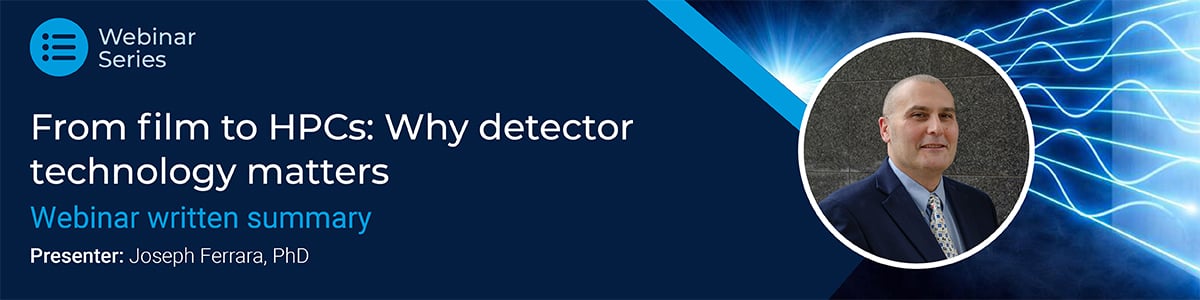
This is a written summary of a live webinar presented on March 4, 2026. The recording and resources are available on the recording page.
Presented by:

This webinar makes the case that detector choice is not a side detail in single-crystal diffraction, because the detector largely determines what you can measure reliably, how fast you can measure it, and how much “extra” signal gets mixed into the data before you ever start integration and scaling.
Joe starts by defining what “good” looks like for a diffraction detector in practical crystallographic terms. You want enough sensitivity to see weak reflections, enough dynamic range to record weak and strong reflections in the same exposure without sacrificing either, enough spatial resolution to separate closely spaced spots, and enough accuracy that the detector contributes as little noise and distortion as possible. Speed matters too, because modern sources can deliver photon rates that will simply overwhelm a slow detector. The ideal detector would report only where each diffracted photon landed, without adding spurious events (cosmic rays, fluorescence, electronic noise) or needing heavy corrections to make the image look like what actually hit the sensor.
From there, Joe walks through the historical arc of detector development and links each technology to the kinds of compromises crystallographers had to accept at the time. Early diffraction relied on photographic plates and film: genuinely parallel capture of an entire pattern, but with analog intensity estimation and substantial human and workflow error unless you used densitometry and careful calibration. Ionization chambers, then Geiger-Müller and scintillation counters, brought electronic readout and solid intensity accuracy, but they forced serial data collection because the instrument effectively scanned reflection by reflection. Multi-wire proportional counters were an early electronic area detector and introduced photon counting in an instrumental sense, but with limits imposed by gas physics (ion cloud size affects spatial resolution) and by how quickly individual events can be processed before the next photon arrives. Image plates offered high sensitivity and wide dynamic range over large areas, but they introduced slow readout and dead time between exposures. CCD area detectors then became a major step: X-rays are first converted to visible light in a scintillator, the light is transported (often through a fiber optic taper), and a CCD is read out serially. That architecture enabled powerful instruments, but the signal path is long, and every conversion/coupling/readout stage is another chance to lose photons, smear position information, or accumulate noise.
Joe then pivots to what changed in the “modern era”: semiconductor area detectors, especially CMOS-based designs and, most prominently here, hybrid photon counting (HPC) detectors. A key point is that not every detector marketed as “photon counting” is doing the same thing. Joe distinguishes software-like or thresholded counting concepts from hardware photon counting, where each individual X-ray event is detected, discriminated, and counted as an integer at the pixel level. In this framing, photon counting is not just “low noise”; it’s event-level accounting. The detector should ideally return integer counts per pixel with true zeros where no X-rays were recorded.
Why is that such a big deal? Because a large fraction of what makes difficult datasets difficult is not the brilliance of the source or the sophistication of the refinement; it’s separating tiny Bragg intensities from background and detector-added artifacts. Joe emphasizes two HPC advantages that directly target that separation. First, energy thresholds allow the detector to accept photons around the source energy while rejecting a substantial amount of unwanted signal (for example, lower-energy fluorescence or other spurious events), which drives down background. Second, the architecture is designed to avoid the common “readout noise plus background subtraction” failure mode that can leave nonzero signal where physically there should be none.
To make that concrete, Joe proposes simple “home lab” tests that reveal whether a detector behaves like a hardware photon counter. One is a background-style test that looks for long, flat plateaus of zeros in regions that should have no illumination; if the baseline wanders, shows non-integer values, or never truly reaches zero, that’s evidence that noise and post-processing are being baked into the image. A second, quicker version uses X-rays and the beam stop: behind the beam stop, the correct answer is zero counts (not “close to zero,” not negative values after subtraction, and not rounded floating values). Misleading color tables and background subtraction can mask these issues, so the raw data are what matter.
With that groundwork, Joe connects detector behavior to real experimental outcomes. For high-end measurements like charge-density work—where you often want extremely high resolution and you need weak high-angle data without sacrificing strong low-angle data—HPC detectors are presented as enabling technology because they can handle very high per-pixel count rates and still preserve weak intensities in the same frames. This reduces the need for workarounds like multiple exposure strategies, heavy attenuation, or elaborate schemes to avoid saturating intense spots. Joe also demonstrates the practical implication of fast, low-noise counting: ultra-fast datasets become realistic, including a short full data collection followed immediately by structure solution, meant to illustrate that detector throughput can turn what used to be a long procedure into something approaching “real-time” crystallography for suitable samples.
A particularly instructive example is a metal–organic framework (MOF), used specifically because MOFs combine several detector-hostile features: large solvent-filled cavities (so less diffracting material), substantial diffuse/background scatter from disordered content in channels, and intrinsically weaker Bragg intensities. When the background itself is high, detectors that convert X-rays to light and then to charge can accumulate large baseline charge and noise, making it harder to pick out weak Bragg peaks riding on top of scatter. In contrast, the HPC approach is presented as maintaining usable spot discrimination even with strong background, yielding a structurally interpretable dataset in a case where high detector background would be a show-stopper.
The Q&A reinforces a few practical points crystallographers tend to care about. The discussion touches on sensor absorption versus X-ray energy (for example, using harder radiation such as molybdenum): the answer offered is that this is handled analytically through correction, so it is not treated as a fundamental barrier. Pixelation in an HPC detector is explained in terms of the hybrid construction: a continuous silicon sensor is electrically coupled to per-pixel readout electronics through bump bonding, and the resulting electric-field geometry defines the pixel behavior. For charge-density specifically, the exchange underscores that very high resolution is the driver, which tends to push users toward harder radiation (molybdenum or even higher energy) depending on the method and targets. Finally, on future directions, the aspirational endpoint described is a monolithic detector where the sensing and counting electronics are integrated into a single wafer while retaining true photon counting, and the difference between flat and curved detector geometries is clarified as module arrangement: curved detectors wrap multiple flat modules around a cylindrical surface to increase angular coverage.
Key questions answered in the webinar
-
A good detector does five things well at the same time. It is sensitive enough to measure weak reflections without burying them in background. It has enough dynamic range to record very strong and very weak reflections in the same image without saturating the strong ones or sacrificing the weak ones. It has high spatial resolution so neighboring reflections don’t smear into each other. It adds as little extra noise as possible so the measured intensities are dominated by the crystal, not the electronics. And it is fast enough to keep up with modern high-intensity sources without introducing large dead times or forcing slow, serial strategies. The ideal behavior is simple: it reports where diffracted photons landed and nothing else—no extra events that don’t belong in the diffraction pattern.
-
Early photographic methods captured an entire pattern in parallel, which was powerful, but intensity measurement was analog and often depended on human comparison to standards, making it error-prone and slow to quantify. Electronic point detectors (ionization chambers, then Geiger-Müller and scintillation counters) improved quantitative intensity measurement but usually required scanning reflection by reflection, which is inherently slow and serial. The big leap came with electronic area detectors: they recovered parallel capture while keeping electronic readout and digital data handling. Each step in this evolution traded one limitation for another—speed, quantitation, dynamic range, and noise—until modern detectors began to deliver most of those benefits at once.
-
In a true photon-counting detector, individual X-ray events are detected and counted as discrete hits rather than being integrated as a continuously varying signal. The practical implication is that the output should behave like counts, not like an analog image that needs heavy correction and subtraction to become usable. For weak data, this matters enormously: when intensities are small, any added baseline, readout noise, or processing artifacts can distort the meaning of I/σ(I), blur the distinction between “weak but real” and “not there,” and complicate integration. Photon counting is valuable because it aims to keep the measurement rooted in event statistics, rather than in electronics-driven offsets.
-
A scintillator-based detector converts X-rays into visible light first, then measures that light with an imaging sensor. That conversion chain is workable, but it introduces opportunities for spread, loss, and noise, and it typically requires calibration-style corrections to handle non-uniform response and distortions. In a hybrid photon-counting design, the X-ray sensor and the readout electronics are separate components that are electrically connected at each pixel. The sensor can be continuous material, but the pixel behavior comes from the per-pixel electronic connections (formed through bump-bonding) and the electric field that drives charge collection to those pixel contacts. The goal is to preserve event-level counting in each pixel and support high count rates with low baseline noise.
-
Two quick sanity checks focus on the most basic expectation: when there are no X-rays, the detector should read zero. One check uses a “no-signal” situation (for example, a long background-style exposure without diffraction features) and asks whether you see extended regions that are truly zero. If you never see stable plateaus of zero, you are seeing noise. A second check uses a beam stop: behind the beam stop there should be zero counts—meaning exactly zero, not negative values after subtraction, not rounded values, and not non-integer values. The big trap is relying on processed images or color maps that can hide baseline problems; the raw numbers are what you want to inspect.
-
Many real datasets contain a mix of very strong and very weak reflections on the same frame. If the detector can’t handle high per-pixel rates, strong reflections may saturate or distort, and you’re forced into workarounds like extra attenuation or multiple scans to separately capture strong and weak regions. High dynamic range and high per-pixel count-rate capability let you collect intense low-angle and weak high-angle data together, with fewer compromises, fewer special strategies, and fewer “wasted” frames that can’t be used. That directly translates into simpler collection plans and more reliable intensity scaling.
-
Background is often the limiting factor, not the peak height itself—especially when disorder, air scatter, fluorescence, or sample composition produces large diffuse scatter. When background is high, weak Bragg spots ride on top of a large signal floor, and any detector-added baseline makes the problem worse. Energy thresholding can reduce unwanted contributions that don’t match the source energy, driving the background down and improving peak contrast. That’s why low background behavior is so important for challenging materials, where the science lives in reflections that are only modestly above background.
-
Work that depends on trustworthy weak data benefits immediately. High-resolution experiments, where you need to preserve weak high-angle intensities without sacrificing strong reflections, are a prime example. Extremely fast data collection is another: if the detector is fast and the frames remain usable without heavy compromise, full datasets can be collected in seconds and solved rapidly afterward. Finally, challenging samples with large solvent content and strong diffuse scatter—such as porous framework materials—benefit because low background and stable “true zero” behavior make it easier to measure Bragg reflections on top of heavy scatter and still obtain an interpretable structure.

Subscribe to the Crystallography Times newsletter
Stay up to date with single crystal analysis news and upcoming events, learn about researchers in the field, new techniques and products, and explore helpful tips.
Contact Us
Whether you're interested in getting a quote, want a demo, need technical support, or simply have a question, we're here to help.