Application Note SMX043
Summary
The grain-by-grain analysis of powders with three-dimensional electron diffraction (3D ED) and energy-dispersive X-ray spectroscopy (EDS) allows for detailed structural and compositional analysis of heterogeneous powders. In this application, we analyze a biogenic calcium carbonate powder obtained from small quantities of a coral skeleton and find a correlation between crystallinity and trace element ratios.
Introduction
Reef-growing corals are an integral part of diverse marine ecosystems, and the analysis of their calcium carbonate skeletons is relevant to understanding how changing ocean environments impact these ecosystems.¹ The skeletons of hard corals are primarily comprised of calcium carbonate crystallized in the aragonite form, with incorporation of low concentrations of other elements present in seawater, such as Mg and Sr.² The relationship between trace mineral composition of the skeletal crystallites and coral growth is an area of active research.
Here, 3D ED in combination with EDS is explored as a straightforward approach to evaluate both the crystallographic and chemical heterogeneity of a coral skeleton from individual nanocrystals in a single experiment. This approach is an attractive alternative to traditional analyses, like XRD and XRF, given the small amount of material required for analysis and the ability to evaluate crystallinity and chemical composition on the very same grain on the nanoscale.³,⁴
Analysis procedure
- ~3 mg of a coral core sample was ground to generate nanocrystal fragments.
- An automated 3D ED measurement queue was generated to evaluate diffraction from >50 grains.
- A crystal structure was solved from a single aragonite grain.
- EDS measurements were taken on grains of interest for comparative analysis.
Sample preparation
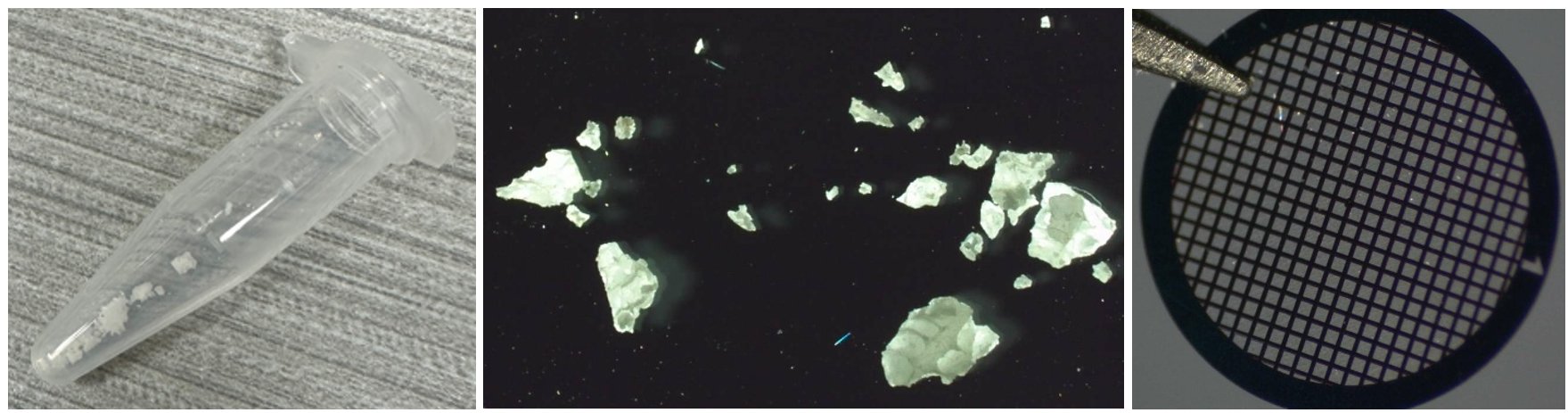
Figure 1: Coral skeleton sample (left), optical image of grains before crushing (middle) and 3 mm TEM grid loaded with crushed nanocrystal fragments (right)
A portion of a ~10 milligram coral skeleton sample was placed between two glass slides and ground to reduce particle size. A 3 mm Cu TEM grid was tapped onto the powder to gather grains for analysis in the XtaLAB Synergy-ED electron diffractometer at room temperature.
Automated 3D ED measurements
Grains were visually located within the XtaLAB Synergy-ED and added to a measurement queue to collect a short wedge (30 °) of continuous rotation diffraction data and obtain unit cell information. Each grain was automatically re-centered, the Z-height adjusted using the “Auto Z” feature within CrysAlisPro-ED, and an automated diffraction measurement collected. The diffraction data is simultaneously processed using automated routines within CrysAlisPro-ED.
After reviewing the datasets in the ED Results Viewer, a larger wedge of data was collected from a grain showing high-quality diffraction to provide the aragonite crystal structure shown below.
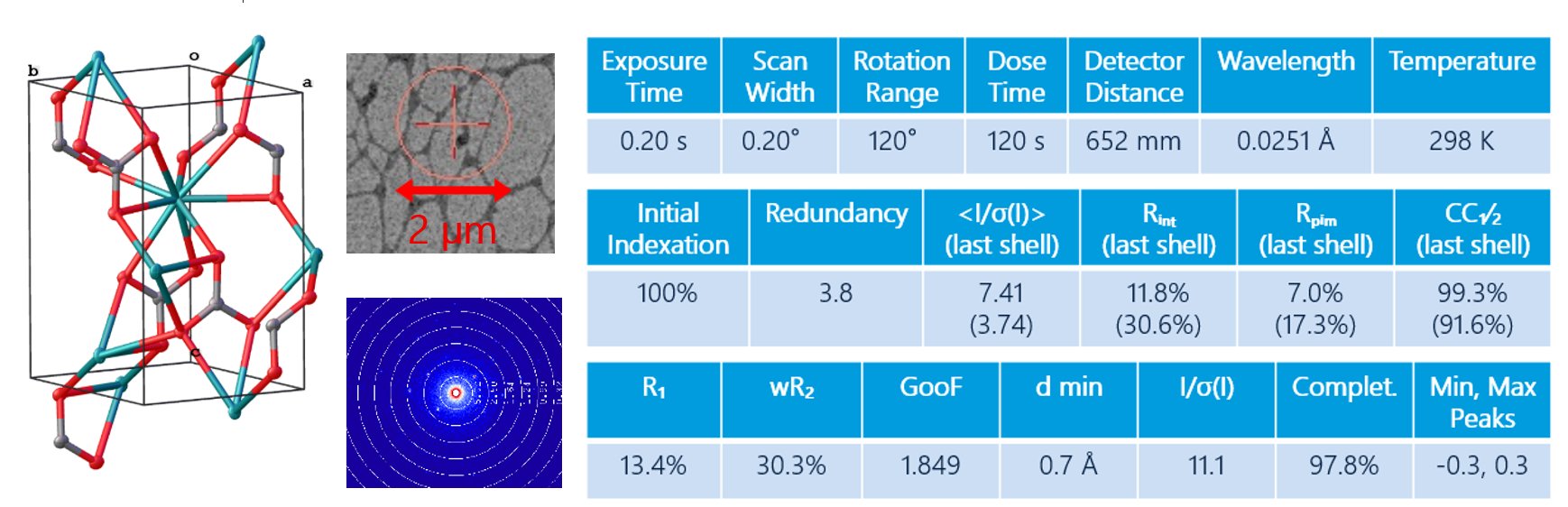
Figure 2: Aragonite crystal structure solved by 3D ED from a biogenic coral skeleton sample: aragonite crystal structure (left), representative grain and diffraction pattern (middle), and data collection, processing, and refinement tables (right; top to bottom).
Integrated EDS measurements
From the automated 3D ED queue results, six grains were chosen for EDS analysis based on their diffraction quality using the ED results viewer. Grains were selected based on indexation quality for the known aragonite unit cell and sorted into two groups: high crystallinity vs. poor crystallinity.
%20and%20poor-quality%20crystal%20(right).jpg?width=1774&height=570&name=SMX043%20Figure%203%20Example%20of%20a%20high-quality%20crystal%20(left)%20and%20poor-quality%20crystal%20(right).jpg)
Figure 3: Example of a high-quality crystal (left) and poor-quality crystal (right). The figure shows an image of the grain, diffraction pattern, and intensity distribution histograms after indexation.
The electron optics were changed to provide a high dose rate with the electron beam focused to ~2 microns in size on the grain of interest using a preconfigured preset within CrysAlisPro-ED. A two-minute measurement was recorded on a JEOL JED-2300T EDS detector for sufficient detection of minor elements present. An identical measurement was recorded approximately 20 microns away from the grains and a background subtraction was performed within JED-2300T AnalysisStation.
Data analysis
Elements of interest (Ca, Na, Mg, Sr) were highlighted within the analysis software and integrated. The values are reported as relative atom percentages using calcium as the reference peak.
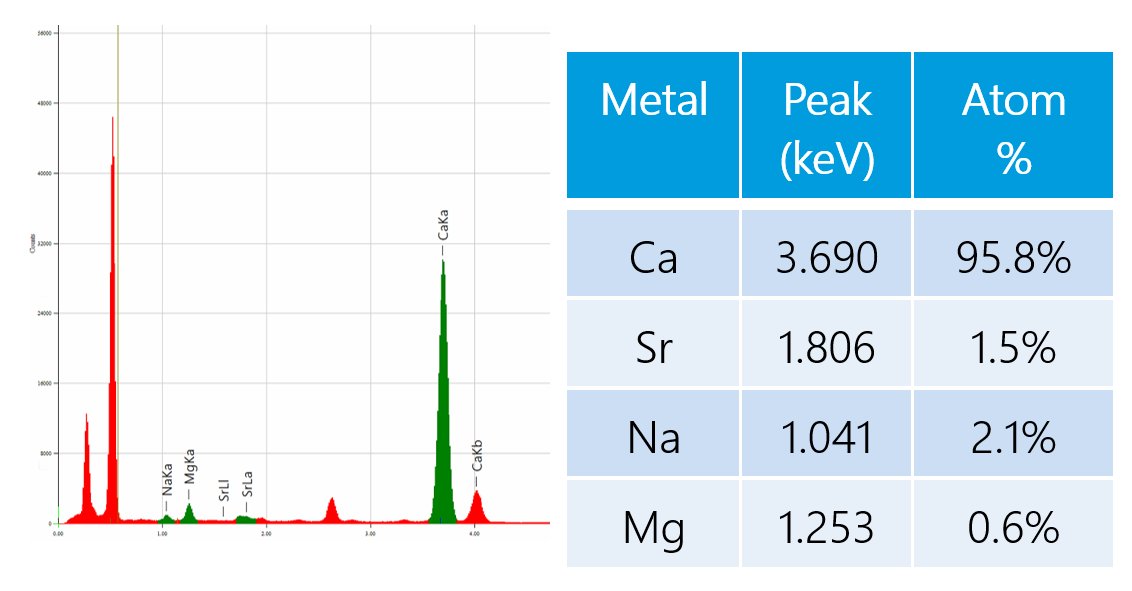
Figure 4: Example of background subtracted EDS spectra and integration results obtained from JED-2300T AnalysisStation.
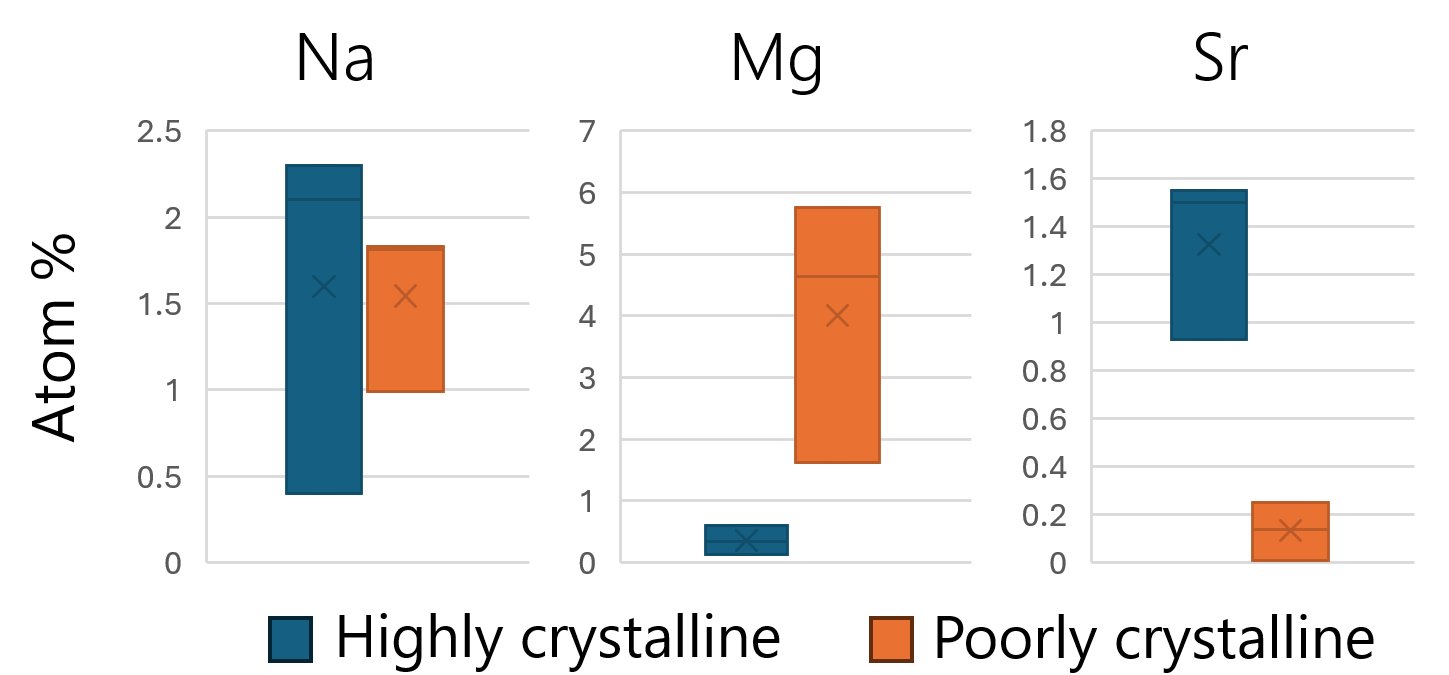
Figure 5: Results of atom % comparison for high- and poor-quality crystallites
A comparative analysis was performed in triplicate on grains with a high degree of crystallinity (as indicated by >80% indexation of reflections) as well as those that were poorly crystalline (<40% indexation). Crystalline grains contained a higher percentage of Sr and lower percentage of Mg relative to the poorly crystalline grains, while Na remained consistent between the two.
Conclusion
The comparative analysis of crystallinity and trace mineral content supports existing literature findings, in which amorphous or poorly ordered calcium carbonate was found in Mg-rich environments, and well-ordered aragonite contained less Mg and higher quantities of Sr.⁵ In this case, we could perform this analysis using a single instrument, with a straightforward and streamlined workflow.
3D ED with integrated EDS allows for an efficient approach to probe crystallographic and elemental heterogeneity on individual nanocrystals within powders. This not only has relevance to analysis directly from natural samples where use of small quantities of analyte is important, but any process where the study of presence or ratios of elements and crystallographic properties is of interest.
References
- Ocean acidification affects coral growth by reducing skeletal density (2018) Mollica N. R., Guo W., Cohen A. L., Huang K.-F., Foster G. L., Donald H. K., Solow A. R., Proc. Natl. Acad. Sci. U.S.A., 115, 1754–1759.
- Corals feel the water chemistry: trace elements in coral skeletons reflect accurately their seawater chemistry, biological and geochemical implications (2025) Ram S., Erez J., Geochim. Cosmochim. Acta, 400, 142–157.
- X-Ray Diffraction Is a Promising Tool to Characterize Coral Skeletons (2013) Rahman M. A., Halfar J., Shinjo R., Adv. Mater. Phys. Chem., 3, 120–125.
- The influence of seawater temperature and pH on the dissolution of coral aragonite (2022) Foster T., Falter J. L., McCulloch M. T., Clode P. L., PeerJ, 10, e13931.
- Analysis of Ca1-xSrxCO3 phases generated by competitive Sr2+ replacement in pre-formed aragonite (2024) Nasser S., Cohen-Taguri G., Mass T., Pinkas I., Goobes G., Heliyon, 10, e36648.
Note:
Another example of analysis with 4D STEM - Exploring Structure and Properties of Diseased Coral Exoskeletons using Multi-scale Electron Diffraction Techniques | Microscopy and Microanalysis | Oxford Academic