Application Note POLYMER019
Introduction
Resin pellets derived from waste plastics are reused as materials for electrical and electronic equipment and automotive parts, but due to RoHS and ELV directives, it is essential to control hazardous elements contained in them. Although general ICP analysis is highly accurate, it is not suitable for on-site screening because of the time-consuming pre-processing such as acid dissolution, dilution, and liquid waste treatment.
With XRF, pellets can be quickly measured as-is, non-destructively and without pretreatment, and by using the standardless FP method, accurate composition analysis can be performed without the need to prepare standard samples or calibration curves.
Elemental analysis
| Analysis: | Recycled materials |
| Use: | Process control, quality assurance |
| Analyzed materials: | Polyethylene (PE) |
| Analysis method: | Standardless FP method |
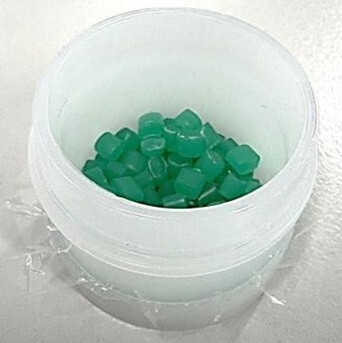
Figure 1: Sample preparation
Table 1: Results of standardless FP analysis of commercial resin samples
(ppm)
| Cr | Br | Cd | Hg | Pb | |
| Standard value | 20.2 | 96 | 19.6 | 4.64 | 13.6 |
| XRF analysis value | 20.4 | 107 | 23.4 | 4.25 | 13.0 |
| Lower limit of detection | 1.8 | 0.2 | 0.84 | 0.41 | 0.6 |
Conclusion
XRF analysis using the standardless FP method was performed on a commercial resin sample, and results for Cr, Br, Cd, Hg, and Pb were all close to standard values. The lower limit of detection was as low as the order of several ppm, confirming the quantitative performance of the method at practical concentrations. It is also effective as an acceptance screening analysis for recycled plastics.