Application Note POLYMER015
Introduction
In the degradation evaluation of polymer materials, it is necessary to determine stability in a wet environment in addition to degradation behavior due to heating. Especially in applications that are exposed to moisture for long periods of time, such as electrolyte membranes for fuel cells and medical devices, there is a risk of overlooking changes caused by water vapor, such as hydrolysis, if only thermal analysis is performed under dry conditions. TG-MS in a water vapor atmosphere can realize the evaluation of reaction and its products in real time, and quantitatively analyze the progress of moisture deterioration. This is effective in developing materials with excellent moisture resistance and in evaluating the reliability of materials for long-term use.
Thermal analysis
| Analysis: | Parts and end products |
| Use: | Process control, failure analysis, quality assurance |
| Analyzed materials: | Polycarbonate (PC) |
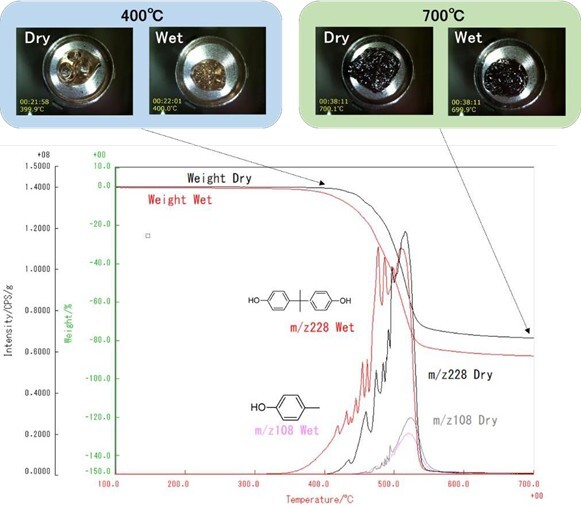
Figure 1: TG and evolved gas behavior of PC in dry and wet atmospheres
Conclusion
When PC was heated under wet and dry atmospheres, clear differences were observed in the decomposition start temperature and residual differences. Furthermore, differences were also observed in the behavior of the evolved gases, suggesting that hydrolysis is accelerated by water vapor. These results indicate that reactions that cannot be understood under dry conditions become apparent in a wet environment. TG-MS measurement under water vapor is effective for understanding risks in moisture resistance evaluation and reliability design.