
Enhancing Pharma Processes
2. Preclinical Development and Preformulation
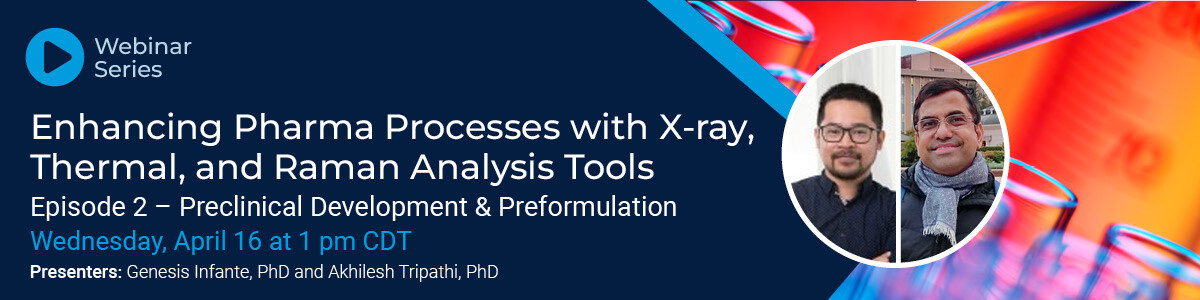
This is a summary of a live webinar presented on April 16, 2025. The recording and resources are available on the recording page.
Presented by:


Webinar summary
This webinar, part of a series on enhancing pharmaceutical processes, explored analytical techniques used in preclinical development and preformulation, with a focus on thermal analysis and X-ray powder diffraction. The session provided practical insights into characterizing drug substances and optimizing formulations through these advanced methods.
Dr. Genesis Infante introduced thermal analysis methods including thermogravimetric analysis (TGA), differential thermal analysis (DTA), and differential scanning calorimetry (DSC). TGA measures mass changes during heating and is particularly useful for identifying events like dehydration, decomposition, and sublimation. DTA and DSC detect energy changes associated with physical or chemical transformations such as melting, glass transitions, and crystallization. The speaker emphasizes the value of these techniques in prescreening samples to avoid damage to DSC equipment, understanding the effects of processing on thermal behavior, and quantifying water content in materials like cyclodextrins under varying humidity conditions.
DSC is also used to assess crystallinity by measuring the energy of melting or the glass transition, and to detect impurities by observing melting point depression or broadening. Modulated DSC allows for separation of reversible and irreversible events, and provides specific heat capacity data, enhancing understanding of subtle transitions. A particularly useful feature demonstrated is the integration of visual sample observation with thermal analysis, allowing researchers to correlate visual changes with thermal events.
In the second half of the webinar, Dr. Akhilesh Tripathi outlined the role of X-ray powder diffraction (XRD) in pharmaceutical analysis. He began with an overview of how XRD distinguishes between crystalline, amorphous, and mesophase materials based on their diffraction patterns. The technique is essential for identifying and quantifying polymorphs, and several methods are available to quantify phase composition. These include traditional calibration curves, semi-quantitative methods using relative intensity ratios, full-pattern Rietveld refinement for structural analysis, and direct derivation approaches that eliminate the need for reference standards.
Akhilesh highlighted how XRD can be paired with DSC for in situ analysis, allowing researchers to track changes in both heat flow and crystal structure during heating or cooling cycles. This combined approach clarifies transformations such as recrystallization or amorphization. He also discussed strategies for handling preferred orientation, a common issue that affects intensity readings in diffraction patterns. Techniques like using transmission geometry, spinning capillaries, and slurry preparation help mitigate these effects.
The session addressed practical challenges in analyzing very small sample amounts, using zero-background holders and advanced detectors to detect samples in the microgram range. It also covered the analysis of air-sensitive materials using airtight sample holders, and liquid or gel formulations using specialized cells. The presentation also explored high-throughput and data-intensive applications. Rigaku’s instruments enable automated analysis of multiple formulations using an XY stage and integrated software for sample tracking. Advanced data analysis techniques like cluster analysis and principal component analysis help classify and quantify phases in complex mixtures.
Key questions answered in the webinar:
-
The webinar focuses on thermal analysis techniques, specifically Thermogravimetric Analysis (TGA), Differential Thermal Analysis (DTA), and Differential Scanning Calorimetry (DSC), and X-ray Powder Diffraction (XRD). These techniques are presented as practical tools to enhance pharmaceutical research and quality control, particularly in the preclinical development and pre-formulation stages.
-
Thermal analysis techniques like TGA, DTA, and DSC provide insights into how materials behave under increasing temperatures. TGA monitors mass changes (loss or gain), indicating decomposition, evaporation, sublimation, or water vapor absorption. DTA and DSC monitor changes in energy or temperature (heat flow), revealing transitions such as glass transitions, phase transitions, melting, crystallization, and exothermic/endothermic reactions. These methods help characterize material properties like mass loss, dehydration, glass transitions, and polymorphism, which are crucial for optimizing formulations and ensuring stability.
-
Both DTA and DSC monitor changes in heat flow as temperature increases. However, DTA monitors the temperature difference between the sample and a reference, while DSC monitors the change in heat flow to maintain the sample and reference at the same temperature. The key difference is that DSC can quantify the energy associated with thermal events (expressed in joules per gram), making it more advantageous for characterizing reactions like melting and crystallization. TGA combined with DTA or DSC (TG-DTA or TG-DSC) is particularly useful for processes involving mass change, such as decomposition or evaporation, where stand-alone DSC is less suited.
-
Prescreening with TG-DTA is highly recommended because the instrument is designed to account for decomposition events that may occur as temperature increases. It continuously monitors mass change and has an outgoing flow to quickly remove any potentially harmful decomposition byproducts. DSC instruments, being more contained, are not as well-designed for samples that decompose, and directly analyzing such samples without prescreening could pose risks to the instrument.
-
XRD is a versatile technique used across the pharmaceutical development pipeline, including pre-formulation. It's used to characterize the solid form of a pharmaceutical sample, determining if it is crystalline, amorphous, or a mesophase. It can identify specific crystal forms (polymorphs) by comparing the diffraction pattern to databases or known standards. XRD also allows for quantitative analysis, determining the amount of different crystalline phases or the percentage of crystallinity in a sample, which is crucial for understanding drug behavior and performance.
-
Several challenges can arise in XRD analysis. Preferred orientation, where crystals align in a non-random way, can distort peak intensities and affect quantitative analysis. This can be minimized using techniques like back or side loading, creating slurries for randomized crystallization, or using transmission geometry with capillary spinning. Analyzing small sample amounts can be challenging but is addressed with zero background sample holders and advancements in optics and detector technology allowing detection of very low concentrations. Air-sensitive or transient samples require airtight sample holders to prevent decomposition or changes during analysis. Special holders are also available for analyzing liquid, gel, and cream samples.
-
Combining XRD and DSC (XRD-DSC) provides a powerful tool for understanding the thermal behavior of materials in real-time. As a sample is heated or cooled, the DSC provides information about thermal events (melting, crystallization, transitions), while the simultaneously collected XRD patterns reveal the structural changes occurring at those specific temperatures. This allows researchers to correlate thermal events directly with changes in crystalline or amorphous phases, providing a more complete picture of the material's behavior.
-
High-throughput screening with XRD involves analyzing multiple pre-formulated drugs or samples quickly, often using specialized plates and automated stages. Once a large dataset of diffraction patterns is collected, cluster analysis can be used to sort and group the data based on similarities in their XRD patterns. This helps in identifying and classifying different polymorphs or formulations. Techniques like direct derivation and component analysis can then be applied to these clusters to perform quantitative analysis without requiring a complete database for each phase.
Contact Us
Whether you're interested in getting a quote, want a demo, need technical support, or simply have a question, we're here to help.