Application Note PHARM024
Introduction
The Impurity Guidelines for Pharmaceuticals (ICH-Q3D) set a permitted daily exposure (PDE) for impurity elements in oral preparations. ICP-OES and ICP-MS are used for the analysis of elemental impurities, but in recent years, XRF has been attracting increasing interest due to its simplicity in sample processing. Polarized optical energy dispersive X-ray fluorescence spectrometers have superior peak-to-background ratios for measurement spectra compared to conventional systems, enabling analysis with higher sensitivity.
Elemental analysis
| Analysis: | Drug substance, additive, formulation |
| Use: | Manufacturing (Production) |
| Analyzed materials: | Cellulose |
| Analysis method: | Calibration method |
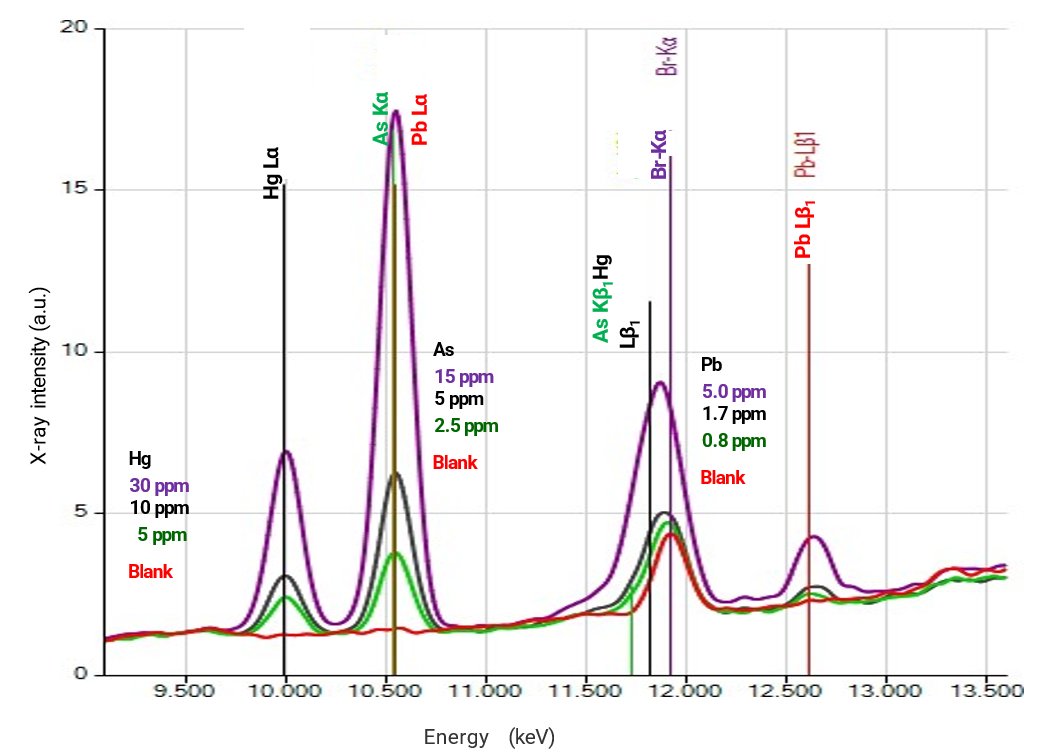
Figure 1: Qualitative spectra of mercury, lead, and arsenic
Table 1: NEX CG II detection limits and permitted daily exposure (PDE) for elemental impurities
| Element | Class | PDE value μg | Concentration limit based on PDE and daily dose | NEX CG II Lower limit of detection μg/g(ppm) | ||
| 10g or less μg/g (ppm) | 5g μg/g (ppm) | 1g μg/g (ppm) | ||||
| Cd | 1 | 5 | 0.5 | 1 | 5 | 0.40 |
| Pb | 1 | 5 | 0.5 | 1 | 5 | 0.08 |
| As | 1 | 15 | 1.5 | 3 | 15 | 0.06 |
| Hg | 1 | 30 | 3 | 6 | 30 | 0.10 |
| Co | 2A | 50 | 5 | 10 | 50 | 0.12 |
| V | 2A | 100 | 10 | 20 | 100 | 0.12 |
| Ni | 2A | 200 | 20 | 40 | 200 | 0.26 |
Conclusion
Clear X-ray fluorescence peaks were obtained from the measurement spectra of cellulose powder samples containing mercury (Hg), lead (Pb), and arsenic (As) in the ppm order. NEX CG II uses polarized optics to achieve a very low detection limit. The sensitivity of this analyzer allows for the analysis of seven trace elements of Class 1 and Class 2A, which are required to be tested under the impurity guidelines for pharmaceutical products.