Application Note PHARM019
Introduction
In many cases, manufacturing sites are forced to ship large quantities of hand sanitizers with limited inspection systems due to increasing demand. Cases have been reported in which some of the ingredients do not meet standards or are contaminated with toxic substances such as methanol, which may not be identified by visual or simple inspections. If such risks are overlooked, it may lead to product recalls and loss of trust. With a portable Raman spectrometer, the authenticity of ingredients can be confirmed quickly and nondestructively on site.
Chemical fingerprinting
| Analysis: | Pharmaceutical product |
| Use: | Formulation /Manufacturing (Raw materials) |
| Analyzed materials: | Hand sanitizer (ethanol) |
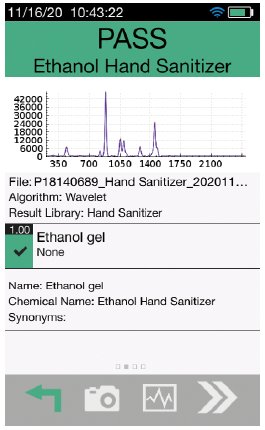 Figure 1: Genuine product Figure 1: Genuine product |
|
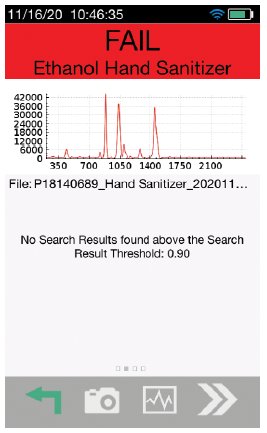 Figure 2: Non-regular products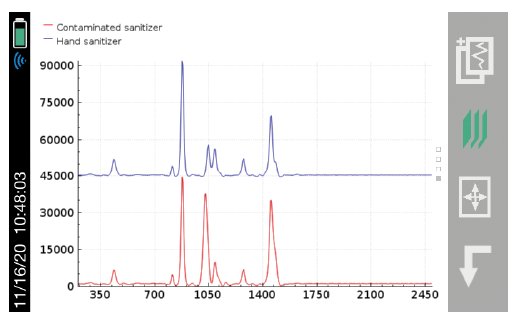
Figure 3: Comparison of Raman spectra
(blue: regular and red: non-regular)
Conclusion
Analysis using a portable Raman spectrometer will show any impurities in a disinfectant. The presence or absence of a substance can be determined immediately on the spot. As shown in Figure 1, the "PASS" mark is displayed for legitimate products, while the "FAIL" mark is displayed for non-legitimate products contaminated with methanol, as shown in Figure 2. As shown in Figure 3, which compares the Raman spectra of the regular product and the non-regular product, a clear peak difference appears around 1000 cm⁻¹. This difference tends to be overlooked by the naked eye. To prevent product recalls and health hazards, a reliable analytical method like this that can be used in the field is indispensable.