

Application Note PHARM017
Introduction
Amorphous APIs are thermodynamically unstable, increasing the risk of crystallization in the formulation. Detection and quantification of the crystalline phase in the whole tablet is essential to accurately determine the presence of crystals. Raman imaging can only observe the tablet surface and may miss any crystallization occurring inside the tablet, while X-ray imaging can visualize the density differences in the internal structure nondestructively and in three dimensions, enabling more accurate confirmation of the presence of the crystalline phase.
Non-destructive imaging
| Analysis: | Dosage form |
| Use: | Formulation (Dosage Form) |
| Analyzed materials: | Fenofibrate |
| Analysis software: | Dragonfly |
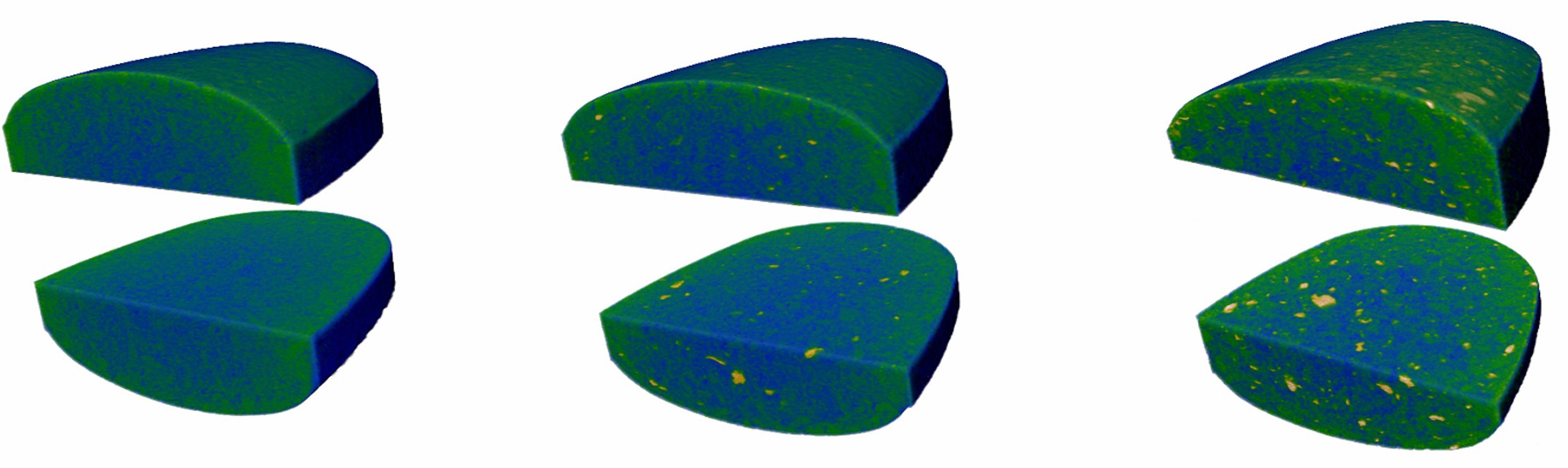 Figure 1: Distribution of crystals (yellow) in amorphous formulation (blue-green)
Conclusion
Figure 1 shows the distribution of crystalline fenofibrate (yellow) added to amorphous fenofibrate tablets (blue-green), with crystal localization clearly visible even in trace amounts. The volume fractions calculated from the CT volume data (0.08, 0.70, and 2.87 wt%) were close to the prepared values. X-ray imaging provides a non-destructive quantitative evaluation of crystals inside tablets and an understanding of crystal distribution, which is difficult to achieve with surface analysis.
Reference
Neilly et al. (2020), J. Pharm. Sci., 109(1), 3078-3085.
DOI: https://doi.org/10.1016/j.xphs.2020.07.006