


Application Note PHARM013
Introduction
Although polyethylene glycol (PEG) is widely used in pharmaceuticals and cosmetics, its degradation during heating and storage can affect the performance and quality of applications. In particular, differences in its molecular weight have an important impact on the thermal stability and components of evolved gases from a sample during the heating process. Consequently, it is essential to evaluate the thermal behavior of PEG according to specified components and measurement conditions. In this study, PEG samples with different molecular weights were performed by thermogravimetric analysis-mass spectrometry (TG-MS) to identify differences in thermal stability and compositions of evolved gases.
Thermal analysis
| Analysis: | Excipient |
| Use: | Formulation (Excipient) |
| Analyzed materials: | Polyethylene glycol |
| Analysis software: | Vullios |
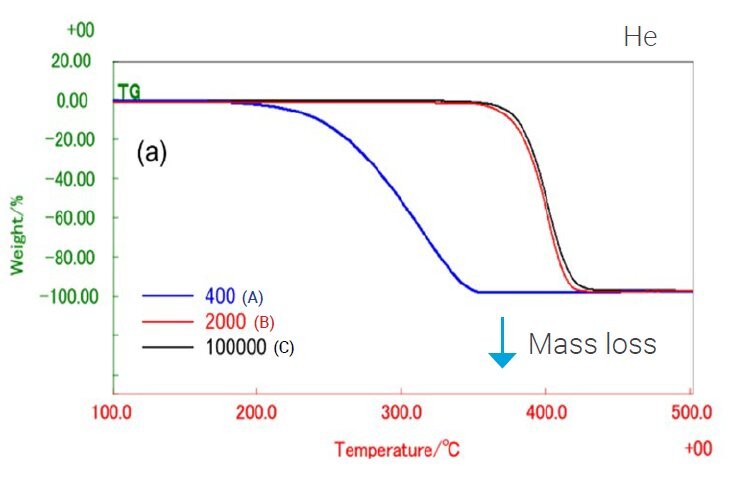 Figure 1: TG results of PEG samples
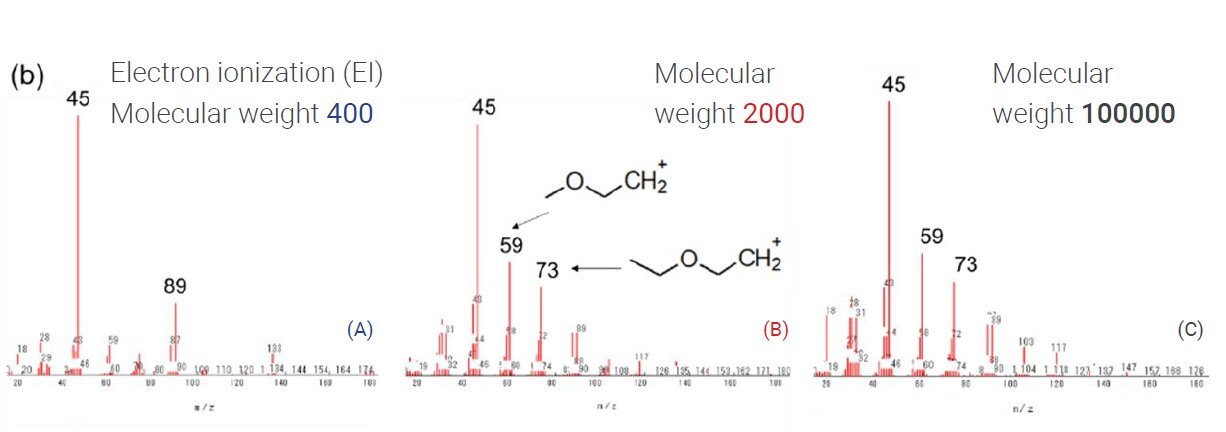 Figure 2: MS results of PEG samples
Conclusion
TG results for PEG samples A (molecular weight 400), B (2000), and C (100000) are shown in Figure 1. The mass loss of sample A, which began around 200°C, was earlier than that of samples B and C, which started around 350 °C. During the heating process, evolved gases from PEG samples were detected by MS as shown in Figure 2. Compared to sample A, evolved gases from samples B and C primarily consisted of mass-to-charge ratio of 59 and 73 of ions. This suggests that differences in molecular weights for PEG samples have an important impact not only on their thermal stability, but also on the compositions of evolved gases during the heating process.