Application Note PHARM010
Introduction
The presence or absence of amorphous material in pharmaceuticals is an important evaluation factor that has a crucial impact on the quality and bioavailability of the pharmaceuticals. Since amorphous materials often feature glass transition (GT), GT detection by differential scanning calorimetry (DSC) is considered an efficient methods. However, if the temperature range overlaps with other thermal reactions, the GT detection may become difficult. Dynamic DSC, which can separate reversible and non-reversible reactions, is an effective approach to resolve this problem. Here differences in GT detection in amorphous and crystalline mixtures were elucidated by both isothermal DSC and dynamic DSC.
Thermal analysis
| Analysis: | Active pharmaceutical ingredients |
| Use: | Pre-formulation (API) |
| Analyzed materials: | Terfenadine |
| Analysis software: | Vullios |
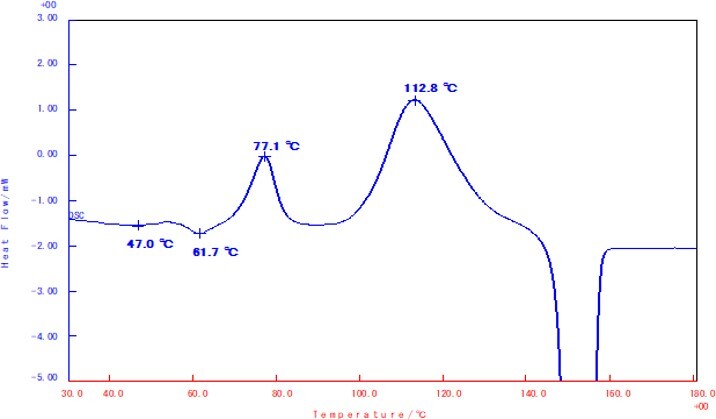 Figure 1: Isothermal DSC results
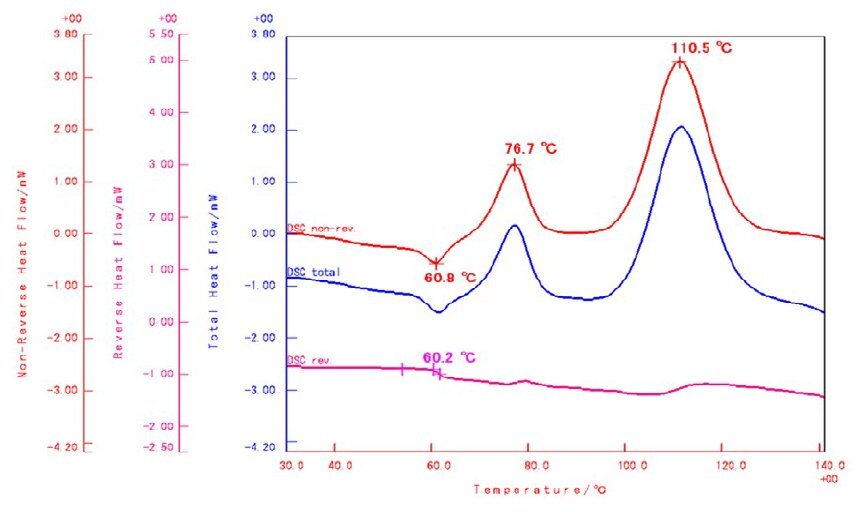 Figure 2: Dynamic DSC results
- DSCtotal: total component DSC
- DSCrev.: reversible component DSC;
- DSCnon-rev.: irreversible component DSC
Conclusion
A mixture of amorphous and crystalline terfenadines (1:1 by weight) did not exhibit a clear baseline shift related to GT on an isothermal DSC curve (Figure 1). In contrast, results of dynamic DSC consisted of DSCtotal, DSCrev., and DSCnon-rev. (Figure 2). A baseline shift exhibited around 60°C is associated with GT on the DSCrev. curve, which represents a reversible reaction.