Application Note PHARM009
Introduction
Differential scanning calorimetry (DSC) is an effective method for quantitative evaluation of thermal properties (e.g., melting and crystallization). However, thermal reactions such as evaporation and sublimation may precede the melting process, making it impossible to accurately capture the desired melting behavior. Moreover, gas species generated from a sample during the heating process may cause sensor damage. Consequently, prior confirmation of measurement conditions by thermogravimetry-differential thermal analysis (TG-DTA) is essential to understand the thermal behavior of unknown samples. Only then is it possible to select appropriate measurement conditions by DSC.
Thermal analysis
| Analysis: | Active pharmaceutical ingredients |
| Use: | Pre-formulation (API) |
| Analyzed materials: | Caffeine |
| Analysis software: | Vullios |
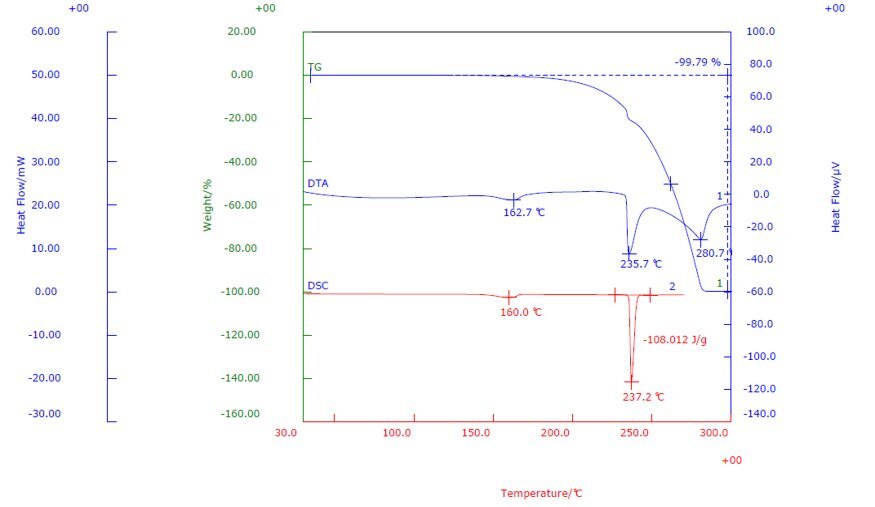
Figure 1: Multiple plots of TG-DTA (blue) and DSC (red) results of caffeine
Conclusion
Caffeine results of TG-DTA and DSC exhibited complex thermal behavior associated with sublimation, melting and evaporation, with almost 100% mass loss between 150℃ and 300℃ (Figure 1). In an open crucible, these reactions may overlap and bury the melting peak, but by using a sealed crucible, a clear endothermic peak at 237 ℃ can be detected, allowing accurate quantification of the melting enthalpy. This method contributes to both reproducible data acquisition and instrument protection.