Application Note PHARM004
Introduction
In drug development, differences in crystal polymorphs affect solubility, stability, and absorption, and have a significant bearing on formulation quality and development strategy. Missing polymorphs can lead to serious risks such as re-testing and delays in patent compliance. Especially in the early stages of development, polymorphs must be identified quickly from a limited amount of samples, and in many cases, large crystals cannot be obtained. Here, we introduce an example of single-crystal X-ray structure analysis in which multiple crystal polymorphs were analyzed from crystals several tens of micrometers in size.
Crystalline phase analysis
| Analysis: | Active pharmaceutical ingredients |
| Use: | Pre-formulation (API) |
| Analyzed materials: | Tolbutamide |
| Analysis software: | CrysAlisPro |
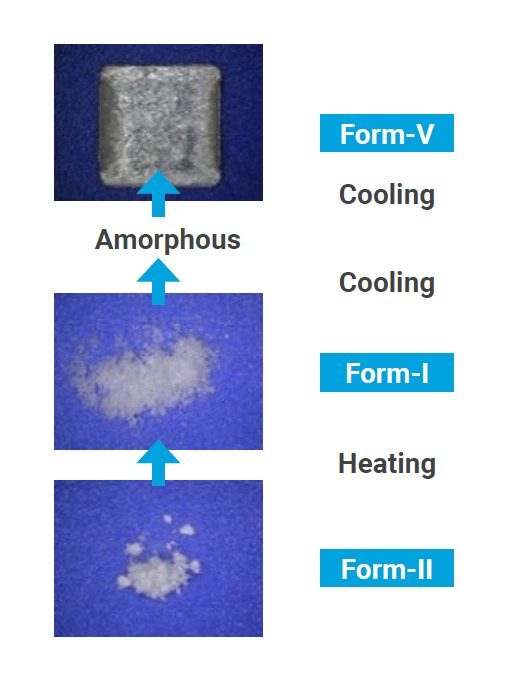 Figure 1: Phase transition
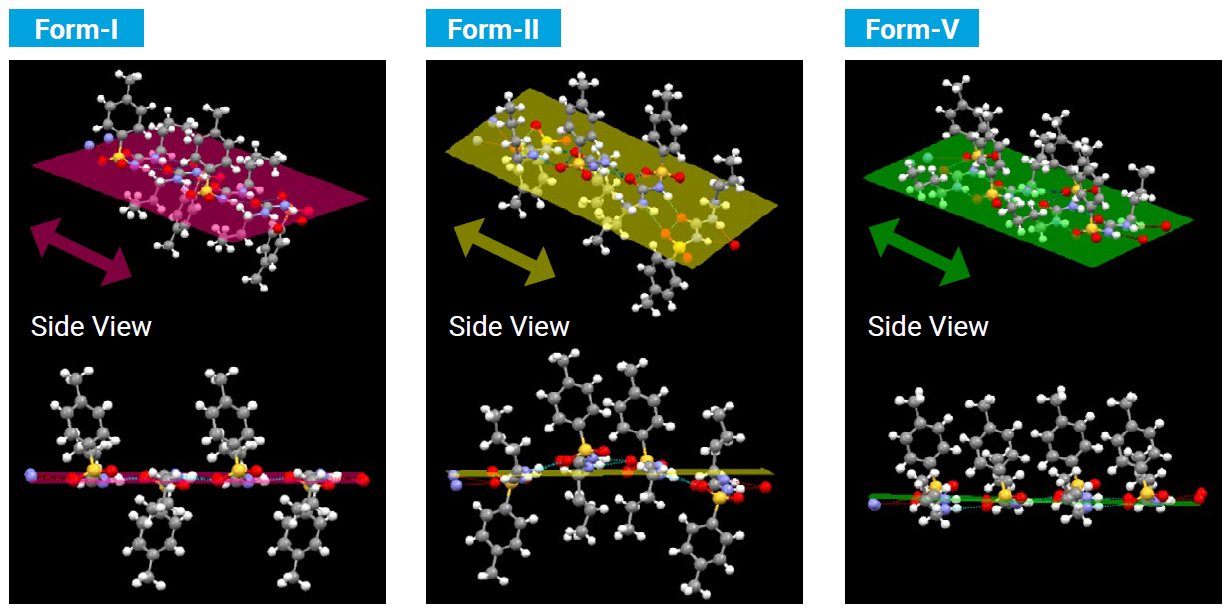 Figure 2: Crystal structure of each polymorph
Conclusion
While monitoring phase transition temperatures by DSC, Form I, II, and V of tolbutamide were prepared, and crystals with a size of several tens of micrometers were analyzed using XtaLAB Synergy-R (Figure 1). The differences in the molecular arrangement of each polymorph were clearly identified in a short time, demonstrating that polymorph evaluation is possible even with tiny crystals (Figure 2). This method is useful for identifying polymorphs in the early development stage, even when it is difficult to grow large single crystals, and for avoiding re-testing and patent risks.