Discover key highlights from IUCr 2026 and new launches. ͏  ͏  ͏  ͏  ͏  ͏  ͏  ͏  ͏  ͏  ͏  ͏  ͏  ͏  ͏  ͏  ͏  ͏  ͏  ͏  ͏  ͏  ͏  ͏  ͏  ͏  ͏  ͏  ͏  ͏  ͏  ͏  ͏  ͏  ͏  ͏  ͏  ͏  ͏  ͏  ͏  ͏  ͏  ͏  ͏  ͏  ͏  ͏  ͏  ͏  ͏  ͏  ͏  ͏  ͏  ͏  ͏  ͏  ͏  ͏  ͏  ͏  ͏  ͏  ͏  ͏  ͏  ͏  ͏  ͏  ͏  ͏  ͏  ͏  ͏  ͏  ͏  ͏  ͏  ͏  ͏  ͏  ͏  ͏  ͏  ͏  ͏  ͏  ͏  ͏  ͏  ͏  ͏  ͏  ͏  ͏  ͏  ͏  ͏  ͏  ͏  ͏  ͏  ͏  ͏  ͏  ͏  ͏  ͏  ͏  ͏  ͏  ͏  ͏  ͏  ͏  ͏  ͏  ͏  ͏ ­ ­ ­ ­ ­ ­ ­ ­ ­ ­ ­ ­ ­ ­ ­ ­ ­ ­ ­ ­ ­ ­ ­ ­ ­ ­ ­ ­ ­ ­ ­ ­ ­ ­ ­ ­ ­ ­ ­ ­ ­ ­ ­ ­ ­ ­ ­ ­ ­ ­ ­ ­ ­ ­ ­ ­ ­ ­ ­ ­ ­ ­ ­ ­ ­ ­ ­ ­ ­ ­ ­ ­ ­ ­ ­ ­ ­ ­ ­ ­ ­ ­ ­ ­ ­ ­ ­ ­ ­ ­ ­ ­ ­ ­ ­ ­ ­ ­ ­ ­ ­ ­ ­ ­ ­ ­ ­ ­ ­ ­ ­ ­ ­ ­ ­ ­ ­ ­ ­ ­ ­ ­ ­ ­ ­ ­ ­ ­ ­ ­ ­ ­ ­ ­ ­ ­ ­ ­ ­ ­ ­ ­ ­ ­ ­ ­ ­ ­ ­ ­ ­ ­ ­ ­ ­ ­ ­ ­ ­ ­ ­ ­ ­ ­ ­ ­ ­ ­ ­ ­ ­ ­ ­ ­ ­ ­ ­ ­ ­ ­ ­ ­ ­ ­ ­ ­ ­ ­ ­ ­ ­ ­ ­ ­ ­  
View in browser
Rigaku_Logo_RGB-1
CystallographyTImes_Header_600x300

Volume 18, No. 8, September 2026

Hi Crystallographer,


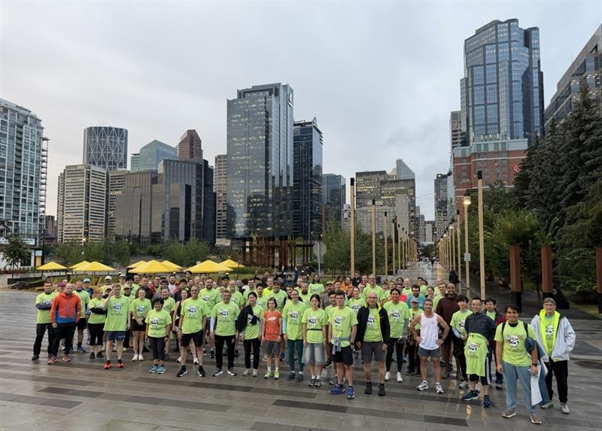
IUCr 2026 has come and gone, leaving us with plenty of highlights and at least one damp but memorable victory lap. Despite the wet weather, the Fun Run may have been the most fun of the week, and it was the first one in my long memory where we ran out of T-shirts.


The exhibition brought its own excitement, with the launch of the PhotonJetULTRA rotating anode, the MaterialsExplorer attachment for multimodal diffraction science, and CrysAlisPro V45. During exhibition hours, the XtaLAB Synergy-ED in the US collected data on 4,000 objects, an overall rate of two objects per minute. 

IUCR funrun

There was also important society news. The American Union of Crystallography became the adhering body for the US, following the defunding and dissolution of the US National Committee for Crystallography. The General Assembly elected a new executive committee and selected Incheon, South Korea, as the site of the 2032 Congress and General Assembly.


The Rigaku community also mourns the loss of Prof. Ada Yonath (1939-2026), whose perseverance and scientific vision helped turn the impossible into the possible. Her contributions to crystallography and structural biology will continue to inspire researchers for generations. Our thoughts are with her family and colleagues.


Also in this issue, Khai shares the Tip of the Month, crystallography makes the news in a big way, we have a fresh movie, and Jeanette returns with a new book review on Logging Off: The Human Cost of Our Digital World by Adele Zeynep Walton.


Joe

Discover More About Rigaku's Single Crystal Tools

Rigaku TOPIQ Webinars

Rigaku has developed a series of  20–30 minute webinars that cover a broad range of topics in the fields of X-ray and electron diffraction, X-ray fluorescence and X-ray imaging. You can watch recordings of our past sessions here.

    Upcoming Events:

    • Norddeutsches Doktorandenkolloqium (NDDK) der Anorganischen Chemie, September 28-29, Göttingen, Germany 

    • ЯÉCIPROCS, September 28 - October 2, Lacanau, France
    See the full Rigaku event calendar

    x_icon_darkBlue
    Follow Us on X (Twitter)

    To keep up to date on the latest news and events from Rigaku Oxford Diffraction, follow our Twitter feed.

    Follow

    Bluesky Circle Icon-01
    Follow Us on Bluesky

    To stay updated on the latest news and events from Rigaku Oxford Diffraction, follow us on Bluesky.

    Follow

    li_icon_darkBlue

    Join Us on LinkedIn

    Our LinkedIn group shares information and fosters discussion about X-ray crystallography and SAXS topics. Connect with other research groups and receive updates on how they use these techniques in their own laboratories. You can also catch up on the latest newsletter or Rigaku Journal issue. We also hope that you will share information about your own research and laboratory groups.

    Join Here

    X-rayForum_2

    Rigaku X-ray Forum

    At rigakuxrayforum.com you can find discussions about software, general crystallography issues and more. It’s also the place to download the latest version of Rigaku Oxford Diffraction’s CrysAlisPro software for single crystal data processing.

    Join Here

    Product in the Spotlight

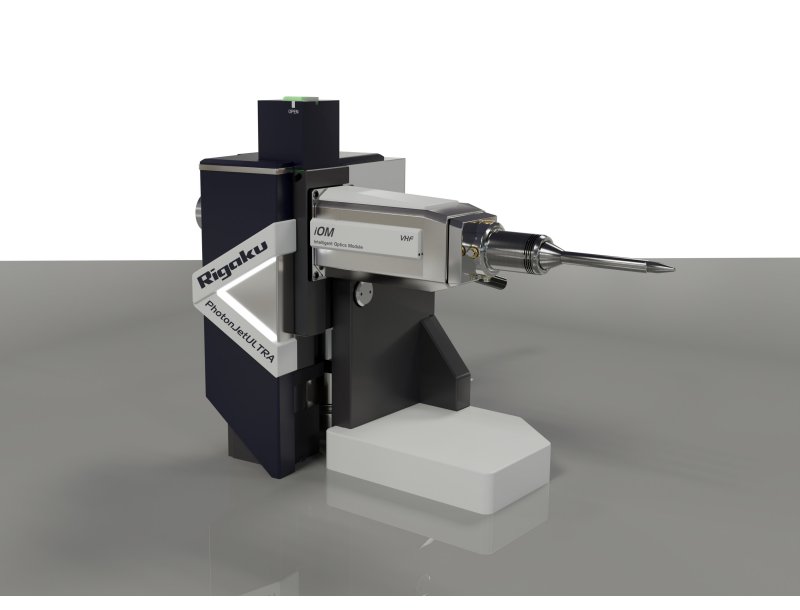
    PhotonJetULTRA

    PhotonJetULTRA

    Adapts to your experiment.


    PhotonJetULTRA combines exceptional source brightness, dual wavelength flexibility and a sample-optimizable beam to make demanding diffraction experiments easier to set up, easier to run and easier to own. From routine measurements to challenging materials, it gives researchers the freedom to adapt the source to the experiment rather than forcing every experiment into the same source conditions.


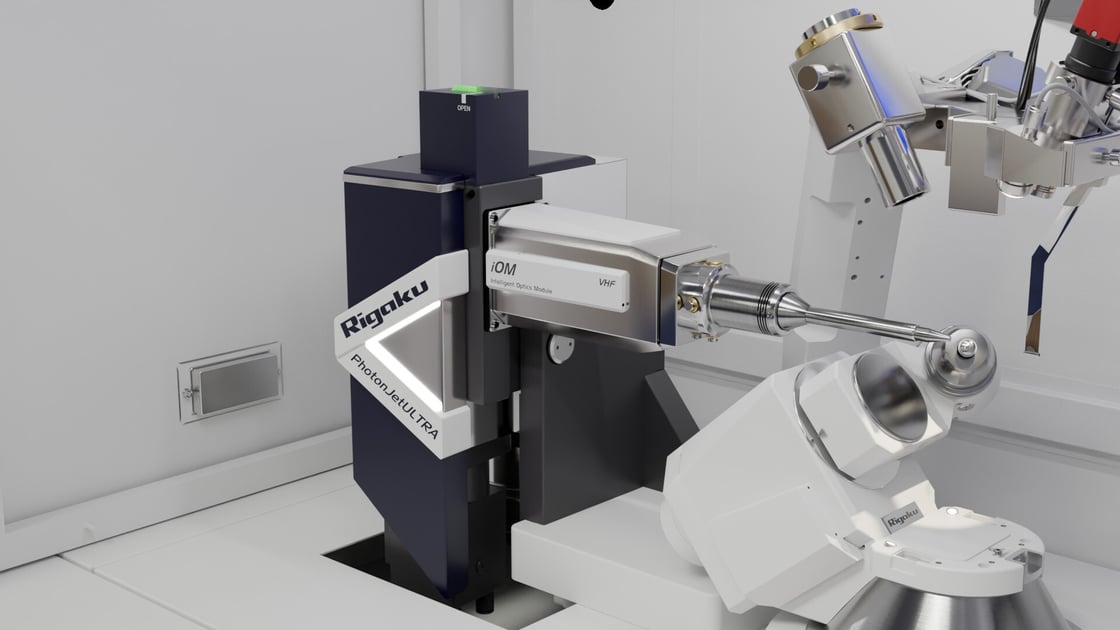
    PhotonJetULTRA on System

    PhotonJetULTRA Overview


    Every experiment asks something different of the source. Sample size, chemistry, scattering power, geometry and measurement goal can all change what the ideal beam should look like.


    PhotonJetULTRA is designed around that reality. It brings together ultra-bright rotating anode performance, dual-wavelength versatility and source operation that can be matched to the task at hand. The result is a source that helps laboratories move more easily between routine work, difficult samples and emerging diffraction workflows.


    Adapt performance to the measurement


    Choose high-performance operation when the experiment needs maximum source capability or use lower-demand operating modes when full output is not required. PhotonJetULTRA helps the laboratory use the right level of performance at the right time.


    Choose the wavelength that suits the sample


    Cu and Mo radiation in a single source give researchers more flexibility to match wavelength to sample, experiment and research program without changing platforms.


    Keep the source easier to live with


    Intelligent operation, source stability and performance-recovery technologies help reduce the day-to-day friction often associated with high-performance rotating anodes, supporting confident use across busy laboratories and shared facilities.


    Four reasons to choose PhotonJetULTRA:


    1. ULTRA bright X-ray source


    Exceptional performance for demanding measurements.


    PhotonJetULTRA delivers the source performance needed when samples are small, weak, complex or time-sensitive. Its ultra-bright rotating anode design provides the performance headroom to collect stronger diffraction data, shorten experiments where appropriate and approach challenging measurements with greater confidence.

    • Helps obtain useful diffraction from weak or demanding samples.
    • Provides additional performance headroom for changing sample sizes and chemistries.
    • Supports throughput-focused measurements where shorter collections are appropriate.
    • One source supports a broader range of samples and applications.
    • Cu/Mo flexibility helps laboratories respond to different research needs.
    • Well suited to shared facilities and research groups with varied sample streams.
    • High-flux and high-brightness operation help match source output to experimental need.
    • Eco and Standby operation help reduce unnecessary wear and power use when full performance is not required.
    • A more adaptable source makes it easier to move between routine work and difficult measurements.

                    2. Dual-wavelength versatility


                    The flexibility to select the radiation that best suits the experiment.


                    With Cu and Mo radiation available from one source, PhotonJetULTRA gives laboratories more freedom to adapt to the sample in front of them. Researchers can choose the wavelength that best supports the measurement, from routine structure determination through to more specialized experiments and diverse material classes.


                    3. Sample-optimizable beam


                    Match the beam to the sample, the measurement and the objective.


                    Different experiments place different demands on beam size, brightness, flux and operating efficiency. PhotonJetULTRA gives users the ability to optimize source conditions for the work they are doing, whether they are prioritizing intensity, brightness, efficiency or long-term stability.


                    4. Designed to make ownership easier


                    High-performance rotating anode sources should not make the laboratory harder to run. PhotonJetULTRA is designed to deliver demanding source performance while reducing operational friction over the lifetime of the instrument.


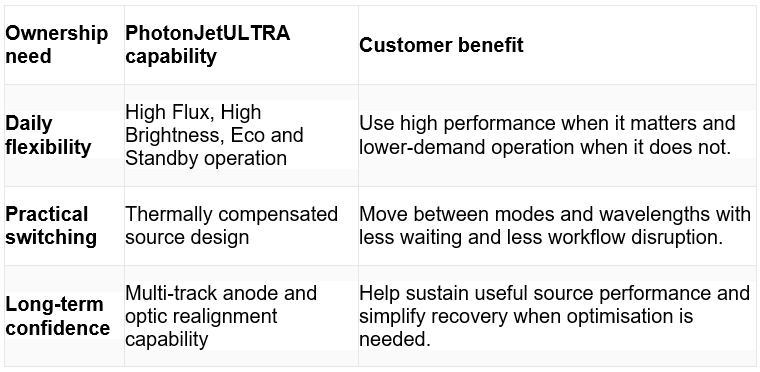
                    Operating modes help users apply the right level of source performance for each experiment. Thermal compensation supports more practical switching between source conditions. Multi-track anode capability and intelligent optic realignment help laboratories maintain or recover beam performance when needed. Together, these technologies help make PhotonJetULTRA easier to use, easier to manage and easier to keep productive.

                    table-1

                    Application breadth


                    Built for a broader range of diffraction experiments.


                    Research programs rarely stay in one lane. PhotonJetULTRA helps laboratories adapt as sample types, materials and measurement goals change. As part of a suitably configured XtaLAB Synergy system, it supports a future-proof view of diffraction that reaches beyond routine single-crystal measurements.

                    • Single crystals, including small, weak or complex samples.
                    • Powders, capillaries, fibers and polymer samples.
                    • Mapping experiments, multigrain studies and high-pressure workflows.
                    • Chemistry, materials, pharmaceutical, academic and shared-facility environments.

                            The common thread is adaptability: the source gives researchers more ways to choose the beam, wavelength and operating mode that fit the experiment they need to run.


                            Ready to adapt your source to your next experiment?


                            Talk to Rigaku about PhotonJetULTRA for the XtaLAB Synergy platform. Whether your laboratory is expanding into new sample types, improving performance for difficult materials or looking for a rotating anode source that is easier to live with, our team can help identify the right configuration.

                            Learn more about PhotonJetULTRA

                            Tip of the Month

                             CrysAlisᴾʳᵒ Tip: Crystal Live View and 360° Crystal Movies 

                            TOTM june

                            This Tip of the Month demonstrates how to use Crystal Live View and crystal movie features in CrysAlisPro to visually monitor your crystal before, during and after data collection.


                            Learn how to open a live crystal video window without interrupting your measurement, record a 360° movie before data collection, adjust the image step size for a more detailed view of crystal orientation and faces, and realign a crystal before continuing an experiment.


                            The video also shows how to manually record a crystal movie after data collection, adjust camera settings, view recorded movies in CrysAlisPro, and organize before- and after-experiment movies for easy comparison.


                            These tools make it easier to document crystal condition and identify visual changes such as movement, changes in color or other differences that may occur during an experiment.


                             Discover more CrysAlisᴾʳᵒ Tips here.

                            Watch the video

                            Crystals in the News


                            July 1, 2026
                            A team of scientists from Canada, France, Indian, Japan, and the US reported that crystals of Diploptera punctata milk store three times as much energy as cow’s milk. This particular item is big news – it is the winner of the 2026 Ig Nobel Prize in Chemistry.


                            July 15, 2026
                            Scientists from Germany, India, Macedonia, the UAE, and the US demonstrate the application of electron diffraction to rapid structural elucidation of crude reaction products.


                            July 29, 2026
                            Researchers from Japan and Sweden have synthesized and characterized a tetranuclear nickel hydride cluster capable of reversible activation of aromatic and aliphatic C–H bonds.


                            August 1, 2026
                            Crystallographers from France and Germany found unusually large modulations in two related organic hydroxy channel structures
                            and used Lissajous curves to visualize the motions of the atoms.

                            Movie of the Summer

                            An AI was used to generate a movie of a plasma jet of the blazar 3C345 from 116 images taken over 27 years.

                            Read here

                            Book Review

                            hbg-title-logging-off-5-87

                            Review:

                            Logging Off: The Human Cost of Our Digital World

                            By Adele Zeynep Walton    

                            ISBN  9781398722941   

                            Adele Zeynep Walton’s Logging Off: The Human Cost of Our Digital World is dedicated to Walton’s sister Aimee, who committed suicide after spending time on an online forum that encouraged its members to take their own lives. This personal tragedy propels Walton’s multi-faceted investigation into the multitudinous negative impacts of digital pervasiveness in our modern world.


                            The book opens with a trigger warning, alerting prospective readers that sensitive topics will be discussed at length. It might seem initially confusing that a book purporting to be about the digital sphere would have trigger warnings for “real-world” problems, but as Walton reiterates time and again throughout Logging Off, the digital world has a constant and consistent impact on the real world, with the two being inextricably intertwined. Indeed, Walton ends her introduction with a note on her language choices throughout the book. She refrains from using “the real world” and “the digital world”, choosing “offline world” and “online world” instead to indicate whether something is happening off the internet or on it. Walton elegantly summarizes our digitally entrenched reality with a simple metaphor: “the online and offline world are now two sides of the same coin.” You cannot have one without the other. 


                            In many ways, Logging Off is half memoir of a Gen Z digital native and half investigative journalism, with Walton seamlessly toggling between her own lived experiences and her findings from dedicated research and interviews. Walton addresses her sister’s suicide and the impact on her personally, but also the general existence of suicide forums and the trouble with policing them. Walton digs into a wide variety of topics, from the dangers of data mining to the sinister algorithms behind social media and the posts that surface on your feeds to the role of social media and online forums in catalysing mental health issues such as eating disorders and body dysmorphia to the labour crisis AI is causing to the false narratives of lived experiences perpetuated on social media. It’s a lot to cover because, as Walton repeatedly argues, there is no real line between the digital sphere and the real world: everything is blurred. 


                            Some of the most poignant anecdotes in the whole book comes toward the very end, in Walton’s chapter on those left behind by digital technology and advancements. She tells the story of a disabled woman without access to a smart phone who tried to contact her doctor about a tumour-like growth and was told to simply send a picture. The woman had to ask a relative to come over, take a picture, and send it to the doctor before even being given an appointment. Digital technology is all about moving forward, but it should not be at the cost of leaving marginalized communities behind.


                            Walton ends Logging Off with suggestions on how to reclaim our offline lives. Some of them revolve around policy changes, like forcing tech conglomerates to put consumer safety first, but her recommendations about shifting our perspectives and prioritizing offline human connection feel the most profound.


                            Review by Jeanette S. Ferrara, MFA 

                            Subscribe to Rigaku newsletters!

                            X
                            LinkedIn
                            Facebook
                            Instagram
                            YouTube
                            bluesky_gray 1

                            © 2026 – Rigaku Holdings Corporation and its Global Subsidiaries. All Rights Reserved.

                            Rigaku Americas - A Division of Rigaku Americas Holding, Inc., 9009 New Trails Dr.

                            The Woodlands, TX 77381 United States

                            Manage preferences or unsubscribe