On October 23, I attended the first WeINSPIREBio Conference, “Celebrating Women in Structural Biology and Drug Discovery,” in Cambridge, Massachusetts. The conference was hosted by Sanofi and supported by NESBA and TrueCourseBio. It was great to see so many old friends, celebrate women in structural biology, and see that crystallography is still relevant. On top of that, I enjoyed the fall foliage in the Northeast.
OlexSys and Rigaku have published a paper titledDynamical refinement against 3D-ED data in Olex2–AutoChem using the N-Beam approach. The paper describes a refinement method based on the Bloch-wave formalism that improves refinement and enables the determination of absolute structure from chiral crystals. This represents a monumental effort to make absolute structure determination from MicroED data easy and reliable.
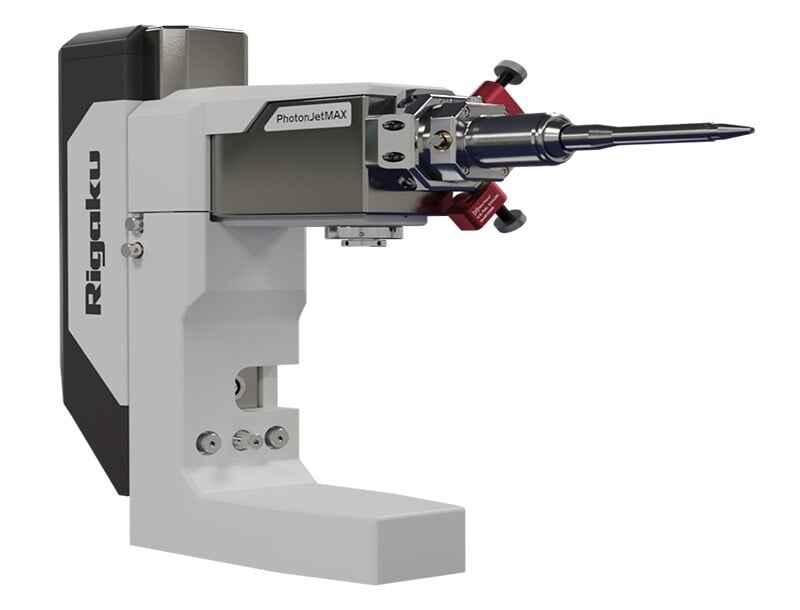
This month, we highlight the PhotonJet MAX-S, our most brilliant microfocus sealed-tube source. Pierre will present a webinar on December 9 demonstrating the power of the PhotonJet MAX-S. A registration link is provided below.
In the Tip of the Month, Jess describes automatic feature selection and data collection for MicroED/3DED. Jeanette reviews Ignorance: What We Do Not Know, Cannot Know, Must Not Know, and Refuse to Know by George G. Szpiro.
For those of you who read Jeanette’s reviews, I am happy and proud to report that she has been selected to receive the ACA’s 2027 Elizabeth A. Wood Science Writing Award. Congratulations, Jeanette!
Please join us for Game Changers: PhotonJetMAX-S - Smaller crystals, faster collections by Pierre LeMagueres, on Wednesday, December 9, 2026, at 3:00 PM GMT (4:00 PM CET, 9:00 AM CST).
Our LinkedIn groupshares information and fosters discussion about X-ray crystallography and SAXS topics. Connect with other research groups and receive updates on how they use these techniques in their own laboratories. You can also catch up on the latest newsletter or Rigaku Journal issue. We also hope that you will share information about your own research and laboratory groups.
Atrigakuxrayforum.comyou can find discussions about software, general crystallography issues and more. It’s also the place to download the latest version of Rigaku Oxford Diffraction’sCrysAlisProsoftware for single crystal data processing.
Double the diffracted intensity, same operating costs
Now available in copper and molybdenum
Maximizing the number of photons hitting your detector can make all the difference, whether you're clearing a backlog of samples or extracting data from a challenging one. The PhotonJetMAX-S, our latest microfocus sealed tube source for the XtaLAB Synergy-S, delivers more than twice the diffracted intensity while maintaining the versatility to handle a wide range of samples.
When designing the PhotonJetMAX-S, our goal was to enhance performance without increasing operating costs. The PhotonJetMAX-S uses the same tube technology as the PhotonJet-S, ensuring that when a replacement tube is needed, the cost remains the same. Additionally, it operates at the same power level as the PhotonJet-S, making it equally eco-friendly.
Enhanced performance
The PhotonJetMAX-S leverages Rigaku Innovative Technologies (RIT) optic technology to maximize photon capture from the tube and focus them onto the sample. Compared to the PhotonJet-S, it delivers over two times more photons to the detector.
Superior stability
Performance and stability go hand in hand. That's why the PhotonJetMAX-S is equipped with our water-to-air cooling approach. Our water-to-air cooling system uses water only where it’s necessary—in a closed, low-pressure circuit—to allow precise control of the source temperature and flux yet ensure reliability. Additionally, water efficiently removes heat from the cabinet eliminating the source as a cause of air turbulence and heat near the sample.
Proven reliability
Built with our long-life tube technology, the PhotonJetMAX-S is designed to keep running sample after sample for years, giving consistent performance and reliability.
Low operating costs
Operating the PhotonJetMAX-S won't break the bank. It uses the same tube technology as the PhotonJet-S, so replacement tubes are no more expensive. Plus, its low operating power keeps energy consumption—and your costs—down.
Eco-friendly design
The PhotonJetMAX-S achieves peak performance at just 50 W, making it the most energy-efficient, high-performance microfocus sealed tube system available.
By choosing the PhotonJetMAX-S, you’re enabling the analysis of smaller samples or increasing throughput as needed. With our patented divergence slits included as standard, you can confidently tackle any sample type, whether it has a large or small unit cell, is a single-crystal or powder, or is a twinned sample.
Automatic Feature Selection and Data Collection for microED/3D ED
How can you efficiently evaluate hundreds or thousands of potential crystals without selecting every position manually? For challenging samples analyzed by electron diffraction, many crystals may need to be screened before a structure can be solved or multiple components can be identified. CrysAlisᴾʳᵒ version 45 introduces “auto-queue,” which automatically identifies features and adds them to a queue for automated data collection and processing.
Auto-queue can be used on all XtaLAB Synergy-ED instruments for selected-area diffraction measurements. On instruments equipped with a Synchronization Unit, serial map screening is enabled. Serial map screening allows for the collection of snapshot diffraction patterns ~10x faster than the standard snapshot diffraction workflow. This Tip of the Month focuses on the auto-queue workflow that is available on all XtaLAB Synergy-ED instruments, including those without a Synchronization Unit.
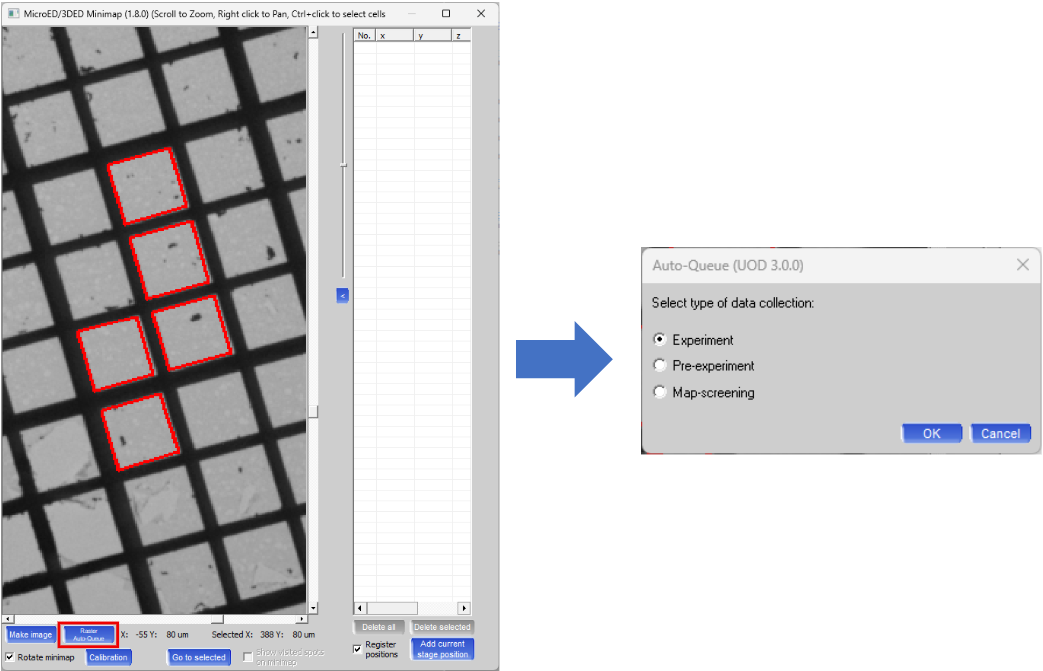
Figure 1: Minimap with selected grid squares outlined in red, followed by the Auto-Queue dialog for choosing Experiment, Pre-experiment, or Map-screening.
If automatic centering will be used, first select the desired auto-centering settings. Adjust Z-height using one representative feature, then acquire a Minimap. An outline appears around each grid square as you move the cursor over the Minimap (Figure 1). Hold Ctrl and click each grid square you would like to measure. After selecting all regions of interest, select “Raster auto-queue” and choose the type of experiment to perform.
The choice between “pre-experiment” and “experiment” depends on the purpose of the screening. A pre-experiment is useful for diffraction snapshots or when only unit cell information is needed. Select experiment when the collected data may be used for structure solution.
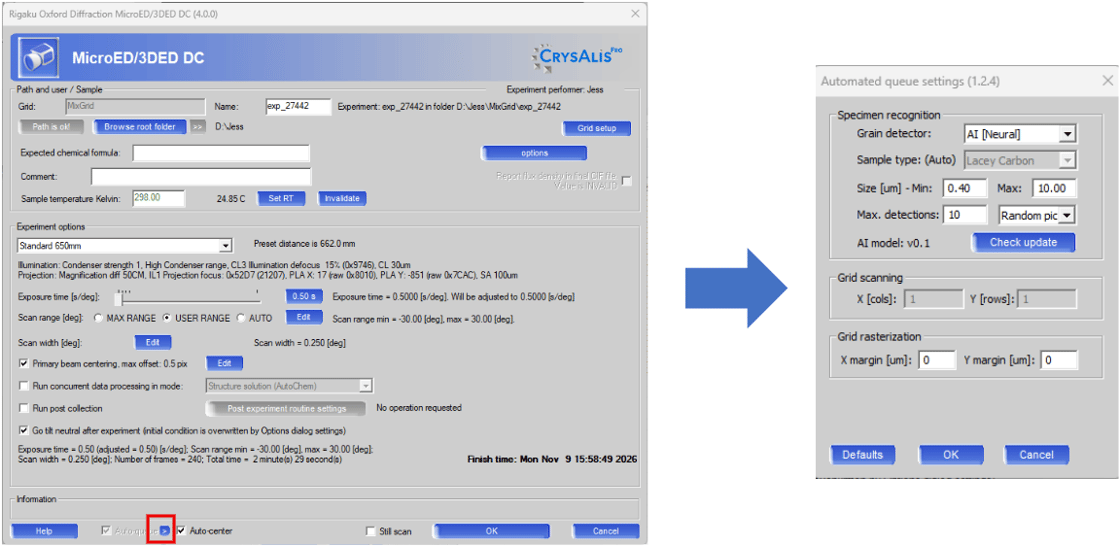
Figure 2:Experiment setup window with the Auto-queue settings control highlighted, followed by the automated queue settings for feature detection, size range, and maximum detections.
In the experiment window, select the auto-queue settings button (Figure 2, left) to define feature recognition settings. Several detection algorithms are available, including an AI-based option. Set the desired feature size range and the maximum number of detectionsfor each Visual Mode field of view (Figure 2, right). Limiting the number of features selected per view is particularly useful for radiation-sensitive samples. The subset of features can be selected randomly or according to a scoring metric.
Figure 3: Prompt asking whether to run auto-queue with data collection; queue window where manual review can be performed.
After the experiment settings have been defined, CrysAlisᴾʳᵒ asks whether to begin data collection (Figure 3, left). Select “Yes” to allow feature identification, centering, measurement, and processing to proceed iteratively without further user intervention. Select “No” to perform feature recognition only. This gives you an opportunity to review the selected features and add or remove some manually before continuing by selecting “Start” (Figure 3, right).
Auto-queue makes it simple to evaluate many potential crystals without user intervention, while retaining the option for user-review before collection. By enabling thousands of datasets to be collected unattended, it unlocks the ability to perform high throughput studies that would be impractical to perform manually.
Crystals in the News
October 13, 2026 Researchers from China have synthesized and characterized a wide IR transparency material,Pb2ScOF5.
George G. Szpiro’s Ignorance: What We Do Not Know, Cannot Know, Must Not Know, and Refuse to Know is an introduction to the study of ignorance. As Szpiro explains in the book’s introduction, the study of epistemology (the philosophical theory of knowledge) is a long-standing discipline that has been around for thousands of years. But the study of the philosophical theory of ignorance is something that has only arisen in the modern era. Szpiro argues that ignorance should be considered a dynamic and ever-shifting construct, breaking down various topics of human ignorance into four categories: things we do not know, things we cannot know, things we must not know, and things we refuse to know. Szpiro offers the disclaimer that these categories, inspired by the Japanese philosophy illustrated in a seventeenth-century carving of three monkeys at the Nikkō Tōshō-gū shrine (see no evil, speak no evil, hear no evil), are not fixed, and that some of the examples he provides could fit in multiple categories.
Szpiro starts with what we do not know, covering subjects ranging from the validity of theories of extraterrestrial existence, to the concept of nothingness and how to define it, to the Dunning-Kruger effect—which is the proposition that people who are most unskilled at a particular task are the most unaware of how unskilled they are. In the next section, Szpiro covers what we cannot know, which includes Heisenberg’s uncertainty principle about the position and momentum of particles in space, the exact length of the coast of Great Britain, and parsing the truth in a world full of alternative facts and fake news. In the third section, Szpiro covers what we must not know. These chapters include an explanation of how insider trading is defined (and the loopholes), the quandary entrepreneurs face when determining whether to file for a patent for their intellectual property, and the psychology of the placebo effect in clinical studies. In the final section, Szpiro explores examples of what we refuse to know. These range from the square root of 2 to the dedicated beliefs of modern-day flat-Earthers to measuring the academic impact of trigger warnings in university courses.
Ignorance has a little over 300 pages and 60 chapters. Each chapter is therefore brief, and Szpiro covers a wide range of topics. Given the brevity of the chapters, each topic is presented and explored in limited detail. If there is a singular chapter (or several) that the reader finds particularly fascinating, they would be best served by reviewing the “Notes” section following the book’s Epilogue, as it lists Szpiro’s sources for further reading. Ignorance is a delightful read, and one which is sure to spark the reader’s interest in at least one, if not many, of the numerous explored examples of the limits of human knowledge.