We break things all the time. But what happens when something fragile meets the floor or the sidewalk? What feels like bad luck turns out to be a universal law of breakage. A new study on how objects shatter suggests that when something breaks, it doesn’t just fall apart—it actively maximizes chaos. From glassware and rocks to bubbles and even spaghetti and sugar cubes, the fragments follow the same statistical “law of maximal randomness,” regardless of the material.
The details vary, but the pattern doesn’t. You can always expect a certain ratio of larger fragments to smaller pieces. For those of us in materials analysis, that’s an oddly comforting thought: behind every spilled box of samples and shattered beaker lurks a tidy mathematical rule. In this issue, as we look at techniques that turn apparent disorder into understandable structure, it’s nice to remember that even the messiest pile of fragments is telling a very orderly story.
As we enter a season filled with holidays, resign yourself to the fact that an ornament or a wine glass or a plate or a casserole dish or a picture frame or your favorite coffee mug might wind up in a pile of shards on the floor. Don’t despair! You’re simply maximizing chaos in an already somewhat chaotic time of year.
This is a double issue. We’ll be back on a regular monthly schedule in the new year.
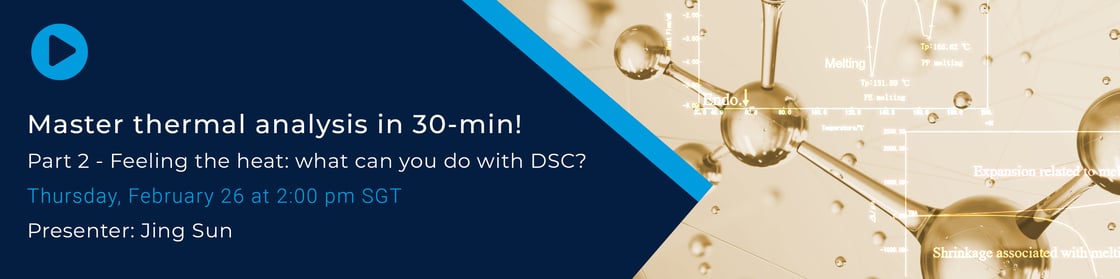
What is really happening inside your material when you heat it?
This webinar reveals how the DSC identifies materials' physical properties in combination with all kinds of accessories, such as a sample observation camera, an automatic sample changer, and cooling units.
Join us for 30 minutes to learn how to unlock the true story of your materials!
Elemental analysis of solids, liquids, powders, alloys and thin films
As a tube-above sequential wavelength dispersive X-ray fluorescence (WDXRF) spectrometer, the Rigaku ZSX PrimusIV delivers rapid quantitative determination of major and minor atomic elements, from beryllium (Be) through uranium (U), in a wide variety of sample types — with minimal standards.
The Large Hadron Collider at CERN is a 27-kilometer underground tunnel on the border of France and Switzerland where scientists accelerate tiny particles to near light speed and collide them to study the fundamental nature of the universe. Built over three decades by thousands of researchers from nearly 100 countries, this multibillion-dollar project raises an important question: why invest so much in smashing particles, and why are scientists now proposing an even larger collider? This piece explores those questions and takes readers inside the facility to understand its purpose and impact.
October 10, 2025: Researchers have unveileda novel 3D printing method that effectively “grows” dense metals and ceramics inside a water-based hydrogel scaffold.. The process prints a gel lattice, then repeatedly infuses it with metal salts that chemically precipitate into metal/ceramic nanoparticles within the structure. After 5–10 cycles and a final thermal step to remove the gel, the resulting parts retain complex geometries while achieving density and strength far superior to conventional polymer-to-metal conversion prints. Test structures (iron, silver, copper gyroids) withstood up to 20× greater pressure and shrank as little as 20% versus typical 60–90%. The technique promises a low-cost route to high-strength, intricate metal/ceramic components for energy, biomedical, and sensing applications.
October 20, 2025: Researchers have developed a surprisingly simple yet powerful method to createseven new high-entropy oxide (HEO) ceramicsby removing oxygen during synthesis. By controlling the oxygen content in a tube-furnace atmosphere, the team was able to stabilize metal combinations including iron and manganese — metals that normally oxidize too strongly to form stable ceramics under ambient oxygen conditions. These new HEOs — all single-phase, rock-salt structured ceramics — hold promise for applications in energy storage, electronics, and protective coatings, marking a significant advance in materials design and synthesis.
November 6, 2025: Researchers at NYU have introduced “Gyromorphs,”a novel class of functional, disordered materials that combine liquid-like randomness with crystal-like structural correlations.. Gyromorphs create a strong, omnidirectional optical “bandgap,” enabling them to block light from all directions — a critical requirement for photonic chips in light-based computers. By overcoming limitations of earlier materials (like quasicrystals), these metamaterials promise to significantly boost signal integrity and efficiency in next-generation photonic computing.
November 12, 2025: Researchers have measured thermal conductivity in single-crystal boron arsenide (BAs) exceeding 2,100 W/m·K, making itthe highest-conductivity material ever recorded and surpassing even natural diamond. This achievement was made possible by advances in ultrahigh-purity crystal growth and refined synthesis that minimized defects previously believed to limit BAs performance. With its exceptional heat-spreading ability and semiconductor compatibility, BAs is now a leading candidate for next-generation thermal management in power electronics, high-density chips, and data-center cooling applications.
November 19, 2025: A research team has discovered thatthe magnetic component of light directly contributes to the Faraday effect, overturning nearly two centuries of scientific assumption that only light’s electric field was responsible. They showed that the oscillating magnetic field of light can generate measurable magnetic torque within materials, accounting for up to 70% of Faraday rotation in the infrared range. Tested on terbium gallium garnet crystals, the findings reveal that light not only illuminates matter but also magnetically influences it. This breakthrough expands understanding of light–matter interactions and could open new pathways in optics, spintronics, data storage, and quantum technologies.
Featured Application Notes
Accurate Quantitative Analysis of Ferrosilicon by the Fusion Method using ZSX Primus III NEXT
Ferrosilicon is one of the most basic materials used in the steel making process. The iron alloys with the content of silicon between 15% and 90% are called "ferrosilicon", and are used in the reduction of the iron, removing oxygen and adding silicon when cast iron or steel alloys are produced.
As part of controlling the steel making process, analyses of slag and raw materials such as quicklime are also required. X-ray fluorescence spectrometers are the most common analysis tools to analyze ferroalloy, slag, steel and added materials owing to the rapid analysis and the ability to measure both bulk metal and powders.
This application note describes accurate ferrosilicon analysis using ZSX Primus III NEXT, which is optimized for process control of steel making and ferrosilicon production.
This application note demonstrates the analysis of coal with specific emphasis on the measurement of sodium (Na), using theNEX CG II. The Rigaku Fundamental Parameters (FP) approach with Matching Library was used for the measurements. Semi-quant FP with no Matching Library is also shown, ideal for screening minor elements and heavy metal content.
Applicability of X-ray Fluorescence Analysis for Lithium-ion Battery Recycling Materials
By Yiqun Wang, and Hikari Takahara
The recycling of rare metals (Li, Ni, Co) from used lithium-ion batteries (LIBs) is important and the demand for compositional analysis of LIB recycling materials is increasing. In this report, the composition of black powder (BP) and black mass (BM), which are LIB recycling materials, was analyzed by X-ray fluorescence analysis (XRF) and the agreement with ICP-AES analysis values was confirmed. BP samples showed good agreement with ICP-AES analysis results using the balance estimation model with the scattering fundamental parameter (FP) method. For heterogeneous BM samples, oxidation treatment and fusion bead sample preparation were carried out to improve the analysis results.
The Opioid Matrix is a podcast for anyone looking for the latest information in the illegal drug supply chain—beginning to end. Each episode will feature a discussion with industry experts about the current opioid crisis, including drug trafficking, drug manufacturing, drug identification, drug addiction, as well as the role of government, law enforcement, new health and social programs, and more.




%20-%20Summer%202025/Rigaku%20Journal%2041-2%20Cover.jpg?width=422&upscale=true&name=Rigaku%20Journal%2041-2%20Cover.jpg)