"I try to identify myself with the atoms ... I ask what I would do If I were a carbon atom or a sodium atom."
(Scroll to the bottom for the answer.)
I can’t say that I’ve ever tried to identify myself with atoms, but it sounds like a fun exercise. Have you ever tried to identify with an atom?
In this newsletter, we highlight an upcoming April webinar focused on medical devices and healthcare products. We also share X-ray CT results on tablets and excipient materials from collaborations with BASF and Natoli. And of course, we include a few practical CT tips.
If you have topics you would like to see us cover in future webinars or newsletters, I’d love to hear from you.
- Angela
Our first webinar of 2026 focuses on medical devices and healthcare products, and the practical challenges manufacturers and quality engineers face when troubleshooting and inspecting these parts. These samples often span a wide range of materials, from polymers to metals, which means scan parameters and data collection strategies must be tailored to both composition and the resolution required to reveal critical internal features.
In this webinar, we’ll walk through how to navigate these common challenges and optimize your approach to consistently produce clear, decision-ready insight.
Registration is free for all of our webinars, and we hope you can join us on April 29, 2026 at 1:00 PM CDT. To reserve your spot, please visit the webinar registration page.
X-ray CT imaging of tablets
Tablet manufacturing sits at the intersection of material science and process control. While tablets remain one of the most efficient and widely used drug delivery formats, their performance depends on the interplay between APIs, excipients, and compression conditions. Subtle changes in formulation or processing can reshape the internal 3D structure, influencing porosity, material distribution, mechanical strength, and ultimately dissolution behavior.
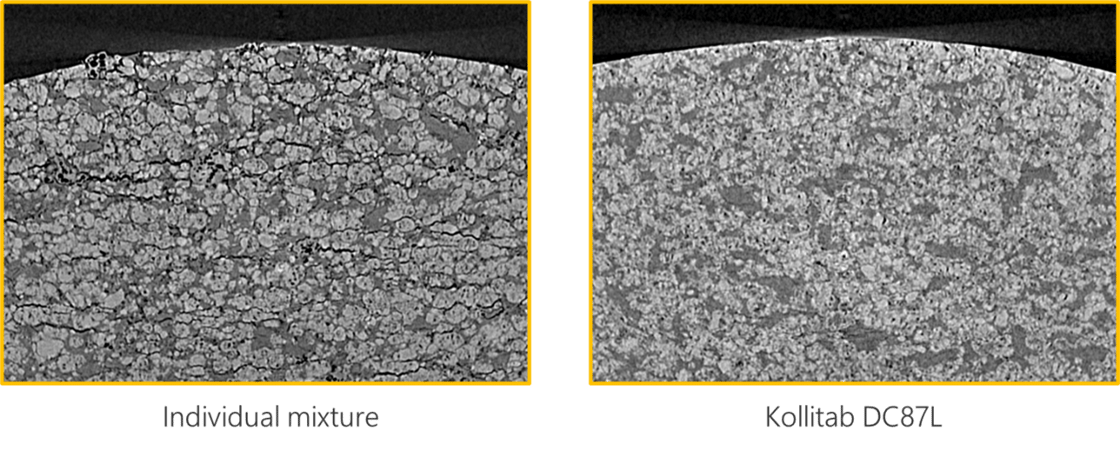
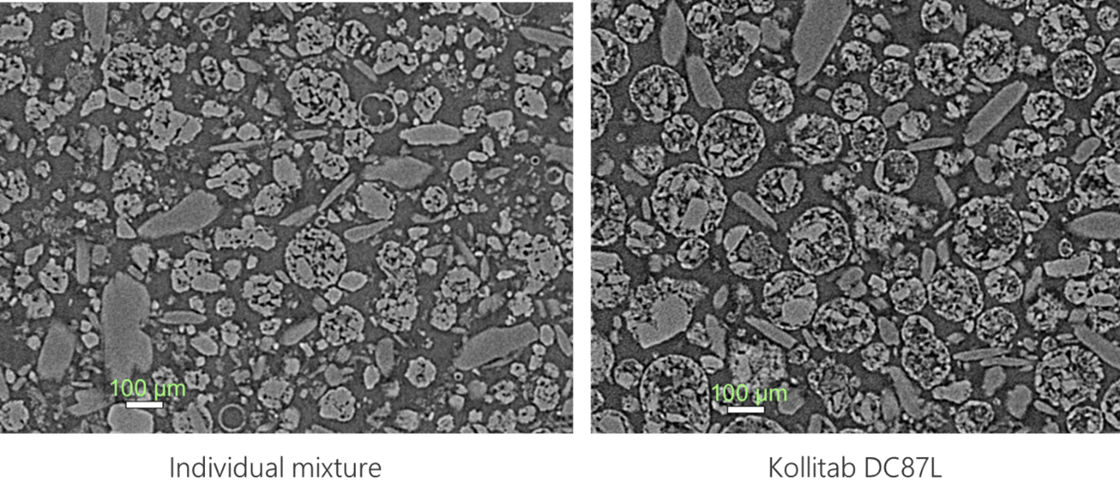
In a recent collaboration with BASF and Natoli, we used X-ray CT to examine tablets formulated with the co-processed excipient Kollitab™ DC87L alongside tablets made from a physical blend of its individual components. The difference was immediately visible in the 3D data.
Tablets produced from the physical blend showed widespread internal cracking, while the co-processed Kollitab material formed a uniform, crack-free structure. These structural differences aligned directly with performance. The co-processed tablets exhibited greater mechanical strength and more consistent drug release, while the physically blended tablets showed higher variability.
We also collected data for the excipient material prior to mixing and tablet formation. There were clear differences there as well.
This example highlights the strength of CT as more than a visualization tool. By linking internal structure to functional outcomes, it provides a direct path to understanding formulation behavior, improving process robustness, and accelerating development decisions.
Artifacts happen when real-world conditions do not match the assumptions made during reconstruction. If a 3D CT scan looks unusual, it might be due to an artifact. Below are three common types of artifacts and tips for reducing them.
Beam hardening (cupping, shading)
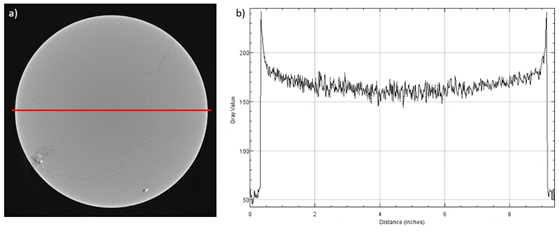
Lower-energy photons are absorbed more readily, causing the beam to “harden” as it passes through the sample. This often appears as reduced gray values in the center of dense objects compared to the edges.
To reduce beam hardening, use metal filters like aluminum or copper to pre-harden the beam, and apply a beam-hardening correction during reconstruction.
Illustration of cupping artifact for a rock core sample. a) 2D cross-section of CT data for rock core. b) plot of the gray value for the red line in a).
Ring artifacts (concentric circles in slices)
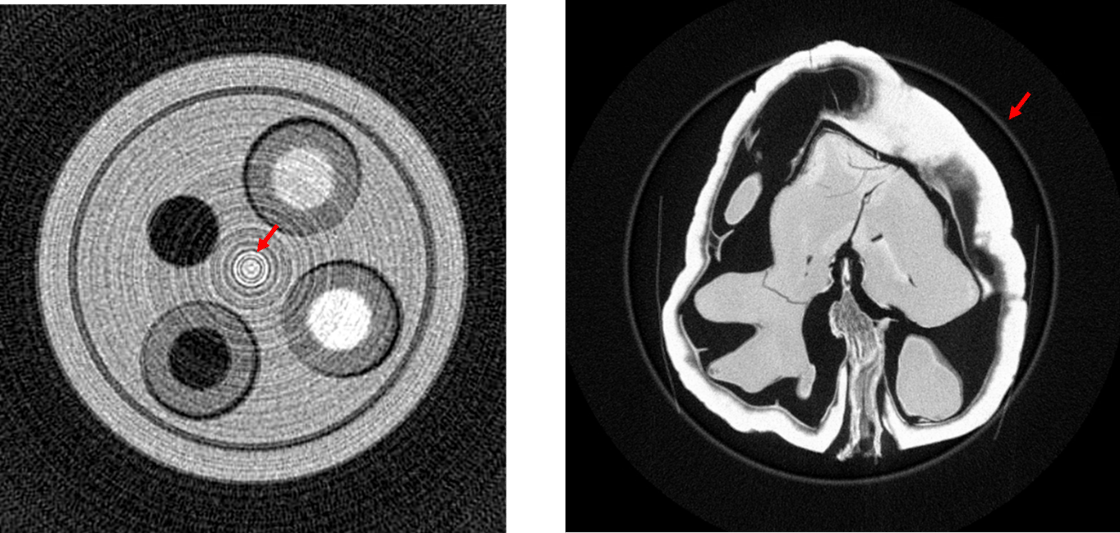
Ring artifacts happen when detector pixels respond differently, even under the same conditions. These show up as concentric rings centered on the rotation axis in the reconstructed images.
To reduce ring artifacts, perform gain calibration before collecting your scan. You can also use manual ring reduction by offsetting the detector or sample between projection images.
Illustration of ring artifacts (red arrows) in 2D cross-sections for maize and walnut data, respectively.
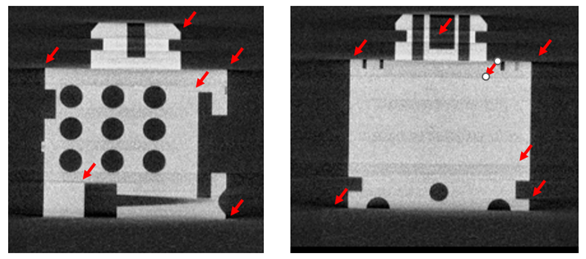
Scattering artifacts appear when X-rays change direction because of scattering or refraction. This often causes streaks in CT images, especially near sharp edges or where flat surfaces line up with the beam.
To reduce scattering artifacts, tilt the sample to change the scan geometry, use filters, and apply scatter correction methods during reconstruction.
Illustration of streaking artifacts (red arrows) for a 3D printed sample.
These artifacts often appear in X-ray CT data and have recognizable patterns. Spotting them early helps you find problems and improve your scan setup.
Real Scientists, Not Actors
A collection of priceless and embarrassing moments curated by Sam Robles.
Linus Pauling
Linus Pauling (1901–1994) was an American chemist and one of the most influential scientists of the 20th century, known for foundational work in quantum chemistry and molecular biology. Over his career, he published more than 1,200 papers and books, advancing the understanding of chemical bonding and molecular structure. Pauling was awarded the 1954 Nobel Prize in Chemistry for his scientific contributions and the 1962 Nobel Peace Prize for his activism against nuclear weapons, making him the only person to receive two unshared Nobel Prizes. His work continues to shape modern chemistry, materials science, and the life sciences.
"I try to identify myself with the atoms ... I ask what I would do If I were a carbon atom or a sodium atom."
That's a wrap. Please let us know how we can help you learn more about X-ray CT. We love to hear from you!








.png?width=320&upscale=true&name=Untitled%20design%20(4).png)